AI Follow-Ups Are Killing Deals: The Fake-Friendly Replies That Make You Sound Like a Robot
If your follow-ups sound polished but empty, prospects feel it. Here’s how to use AI for speed without sounding fake, pushy, or oddly enthusiastic.

Let’s talk about the email that loses business quietly.
Not the angry email. Not the typo email.
The “perfect” AI email.
You know the one:
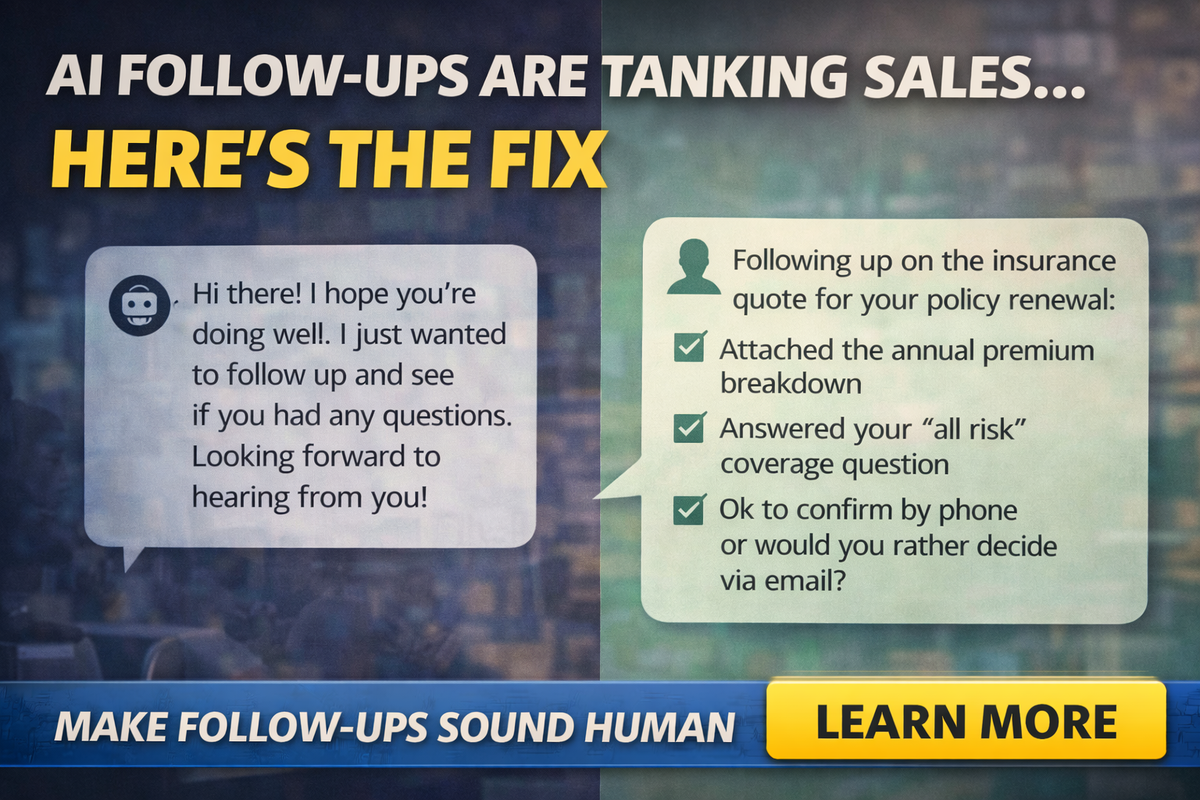
“Hi there! I hope you’re doing well. I just wanted to follow up and see if you had any questions. Looking forward to hearing from you!”
It sounds polite. It sounds professional.
It also sounds like you copied it from a thousand other businesses.
And that is exactly why it can kill deals.
In small service businesses, follow-up is where trust is built. If your follow-up feels generic, prospects assume your service might be generic too.
The problem is not AI. The problem is “AI voice.”
AI is great at producing clean, friendly language. The downside is that it often defaults to a tone that feels:
- over-polished
- oddly enthusiastic
- vague
- repetitive
- emotionally disconnected from the actual situation
Prospects might not say, “This feels like AI.”
They just feel less urgency to reply.
Why it matters more for service businesses
If you sell something simple and cheap, maybe it does not matter.
But if you sell inspections, insurance, coatings, roofing, consulting, or any service where the customer is trusting you with time, money, or a major decision, your follow-up has to feel real.
People want to feel like:
- you remember their situation
- you understand the goal
- you have a clear next step
Generic follow-ups feel like you are spraying messages at random.
The “Fake-Friendly” red flags
If your AI follow-up includes these patterns, fix it:
- lots of filler (“Hope you’re doing well” every time)
- no mention of the customer’s actual request
- no deadline or reason to act
- no clear choice of next step
- “checking in” without value
Here’s a truth that sounds harsh but helps:
A follow-up that adds no value feels like a chore to answer.
The fix: use AI for structure, but add 3 human ingredients
You can keep the speed and lose the robot vibe with a simple rule:
Every follow-up must include:
- Context: what they asked for
- Value: what you are giving them right now
- Choice: two easy next steps
That’s it.
If you do those three things, your follow-ups stop sounding like a template, even if AI helped draft them.
A follow-up formula that closes more deals
Use this structure:
Line 1: Context
“Quick follow-up on the roof repair estimate for the leak near the vent.”
Line 2: Value
“I can fit you in this week, and I included two options depending on whether you want patch-only or a longer-term fix.”
Line 3: Choice
“Want me to hold a spot for Thursday, or would you rather jump on a 5-minute call today to confirm scope?”
That sounds human because it is specific.
The three follow-ups you should automate mentally
You do not need complicated sequences. Most small businesses just need consistency.
Follow-up 1: The “did you see it?” message
Short, specific, no pressure.
Follow-up 2: The “help you decide” message
Adds value: clarifies options, answers one common question, offers a quick call.
Follow-up 3: The “close the loop” message
This one is magic because it reduces awkwardness:
“If timing changed, no worries. Want me to close this out for now, or keep it open until next week?”
People respond to this because it is respectful and easy.
Prompts that keep AI from making you sound fake
If you use AI to draft follow-ups, stop asking:
“Write a follow-up email.”
Ask this instead:
“Draft a short follow-up email in a calm, confident tone. Include:
- a one-sentence reminder of what they asked for,
- one helpful detail that makes deciding easier,
- two next-step options.
Avoid filler and avoid generic phrases.”
Now the output sounds like a real person who remembers the job.
A quick “tone checklist” before you hit send
Ask yourself:
- Does this mention their situation specifically?
- Does this give them something useful right now?
- Does this include an easy choice?
- Does it sound like something you would say out loud?
If the answer is “no,” adjust the first two lines. That is usually all it takes.
Final Thought
AI can absolutely help you follow up faster.
But speed without specificity makes you sound fake-friendly, and fake-friendly does not close deals.
If you want follow-up templates that sound like your business, plus prompt packs your team can use safely, Managed Nerds can build AI-assisted communication workflows that keep your tone human and your process consistent.
Subscribe for more Small Business AI Tips.