
How Do I Turn My Website Into an AI Lead Machine?
AI summaries can steal your clicks, but they can also send you better leads. Here’s how to structure pages, FAQs, proof, and tracking so your site wins in the AI era.

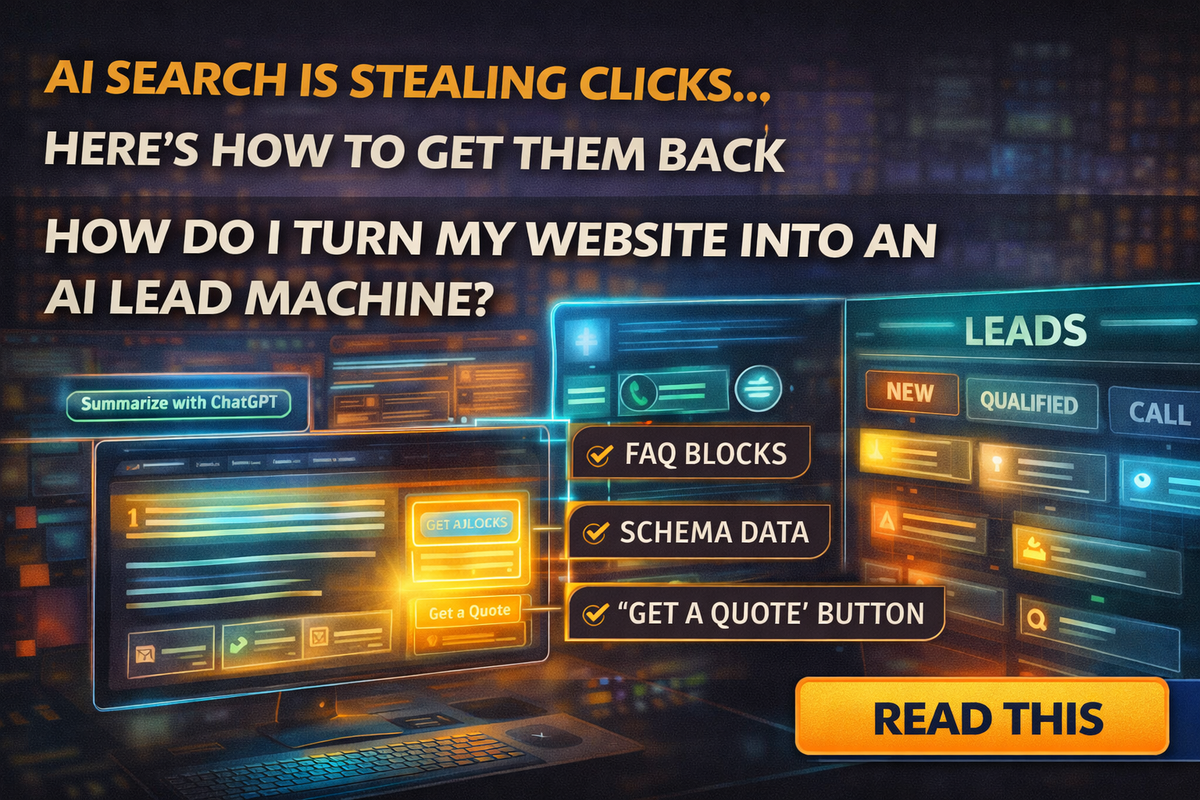
If you’ve noticed fewer clicks from Google lately, you’re not imagining it.
AI answers are changing the flow. People ask a question, they get a summary, and sometimes they never click.
That sounds like bad news… until you realize something:
AI summaries don’t kill demand. They change where demand goes.
The businesses that win now are the ones whose websites are easy for AI to understand, easy for humans to trust, and built to turn “curious visitors” into “ready-to-book leads.”
Let’s turn your website into that.
What “AI lead machine” actually means
This is not about stuffing your site with “AI keywords.”
An AI lead machine is a website that:
- shows up in AI-driven answers and summaries
- earns trust fast (proof, clarity, specificity)
- gives AI quotable, structured content (FAQs, definitions, steps)
- offers an obvious next step (call, quote, book)
- tracks what actually converts
If you’re a small service business, your advantage is you can be clearer and more specific than big generic sites.
The Truth?
AI isn’t stealing your leads. Your site is just too vague for AI to recommend.
When AI summarizes the internet, it favors sources that are:
- specific
- structured
- consistent
- trustworthy
If your page says “We provide quality service at affordable prices,” you are basically invisible to both humans and AI.
Step 1: Build pages around real questions
AI answers are powered by questions.
So your website needs question-shaped content, not brochure fluff.
Examples for service businesses:
- “How much does [service] cost in [city]?”
- “How long does [service] take?”
- “What’s included in [service]?”
- “What should I do before you arrive?”
- “Do you serve [town/area]?”
- “What are the common problems you see with [problem]?”
Make these questions the headings on your pages.
If AI can lift a clean answer from your site, you have a better chance of being referenced, and the visitor who clicks is usually higher intent.
Step 2: Add an FAQ block to every money page
If you do nothing else, do this.
Every primary service page should have an FAQ block with 6–10 questions.
Why?
- Humans skim
- AI summarizes
- FAQs give both of them exactly what they want
Good FAQ answers are:
- short
- clear
- specific
- honest about “it depends” factors
Bad FAQ answers are:
- vague
- salesy
- full of filler
A strong FAQ block is like bait for AI summaries, in a good way.
Step 3: Turn “trust” into visible proof
AI and humans both look for proof signals.
For humans:
- photos, reviews, credentials, clear process, examples
For AI:
- consistent business details, clear service definitions, structured sections, strong about page, location cues
Add proof sections that are easy to scan:
- “What’s included”
- “Common problems we solve”
- “Our process”
- “Photos of recent work”
- “What customers say”
- “Service areas”
This reduces bounce, increases conversions, and makes your content easier to summarize.
Step 4: Create a “source of truth” content style
AI gets confused when your site contradicts itself.
If one page says you serve “Augusta,” another says “CSRA,” and another lists ten towns, AI and customers both hesitate.
Pick a consistent format for:
- service area language
- hours and response times
- service descriptions
- pricing factors
- policies (cancellations, deposits, warranties)
Consistency is underrated, and it’s one of the easiest wins for small businesses.
Step 5: Add a “Summarize this page” lead hook
Here’s a modern strategy that can pull attention back to you:
Add a button or block that says something like:
- “Want a quick summary? Copy and paste into ChatGPT using this prompt”
- “Get the short version”
- “Ask AI about this service”
You’re not trying to replace your content. You’re trying to:
- make it easier to consume
- make it easier to share
- keep the visitor on your page longer
- give them a guided next step
A simple version can be:
“Copy this prompt:”
“Summarize this page in 6 bullets, then tell me what questions I should ask before booking.”
Then you follow it with:
- “Ready for a quote?” button
- phone number
- booking link
This is how you turn AI curiosity into action.
Step 6: Build “conversion landing zones” for AI traffic
AI traffic often arrives mid-journey. They already know the basics.
So give them fast paths:
- “Get a quote in 60 seconds” form (name, phone, zip, short description)
- “Text us photos for a quick estimate”
- “Book a call” link
- “Check service availability by zip code”
Your goal is to reduce friction.
If the next step requires effort, they bounce. AI doesn’t fix that.
Step 7: Track what AI traffic actually does
If you don’t track, you’ll guess wrong.
Basic tracking you should have:
- form submissions
- click-to-call
- booking button clicks
- key page visits (service pages, contact page)
And if you want to get smarter:
- use simple UTM links on your main CTAs
- create a dedicated “AI visitors” CTA variant and compare results
The best businesses don’t just “get traffic.” They measure the parts that lead to money.
Step 8: Write like a local expert, not a generic company
AI summaries reward specificity.
Instead of:
“We offer high-quality service.”
Write:
“We handle [specific service] for [specific customer type] in [specific areas]. Here’s what’s included, typical timelines, and how pricing is usually calculated.”
This works especially well for:
- trades
- home services
- realtors
- small insurance agencies
- consultants
The more concrete you are, the easier it is for AI and people to trust you.
A quick “AI lead machine” checklist
If you want a simple punch list:
- Service pages built around real questions
- FAQ block on every primary service page
- Proof sections: what’s included, process, photos, reviews
- Consistent service area and policy language across the site
- Strong CTAs that reduce friction
- Optional “Summarize this page” prompt block
- Tracking for calls, forms, booking clicks
That’s the foundation.
Final Thought
AI answers are changing search, but they’re not the enemy.
They’re a filter.
If your site is clear, structured, proof-heavy, and conversion-focused, AI can send you higher-quality leads, not fewer leads.
If you want help turning your website into an AI-ready, lead-generating system (content structure, FAQs, tracking, and conversion upgrades), Managed Nerds can build it in a way that actually fits small businesses.