Your Team’s AI Is a “Shadow Employee”: The Hidden Risk of Everyone Using Different Tools
If everyone on your team uses a different AI app, you do not have “AI adoption.” You have a shadow employee you cannot manage. Here’s how to fix it fast.


If your business has employees, contractors, or even one helpful assistant, there’s a decent chance AI is already in your company.
Not because you rolled it out.
Because someone started using it quietly.
A browser extension here. A free app on a phone there. A personal account for “just this one email.” That’s how “shadow AI” shows up in small businesses: casually, quickly, and with zero guardrails.
And it is not a small problem anymore.
Security reporting and research are showing a clear trend: unsanctioned use of AI tools is widespread, and employees are regularly sharing sensitive business data into tools the company did not approve.
So let’s call it what it is.
If your team is using different AI tools without a plan, you have a shadow employee, and you cannot manage what you cannot see.
What “shadow AI” looks like in real life
It rarely looks like a hacker movie. It looks like this:
- Someone pastes a messy client email thread into an AI tool and asks for a reply.
- Someone asks AI to rewrite a proposal and drops in pricing, terms, or scope.
- Someone uses a “free” summarizer extension that can read the page they are on.
- Someone uses a personal AI app to draft follow-ups because it is faster than the company system.
Nobody thinks they are doing anything wrong. They are just trying to move faster.
Why it becomes a business risk, fast
A recent report covered by TechRadar described a jump in generative-AI-related data policy violations and noted a large share of usage happening through personal or unapproved apps, which organizations often cannot monitor.
Even if your business is tiny, the risk is the same:
- Client data exposure (names, addresses, policy details, invoices)
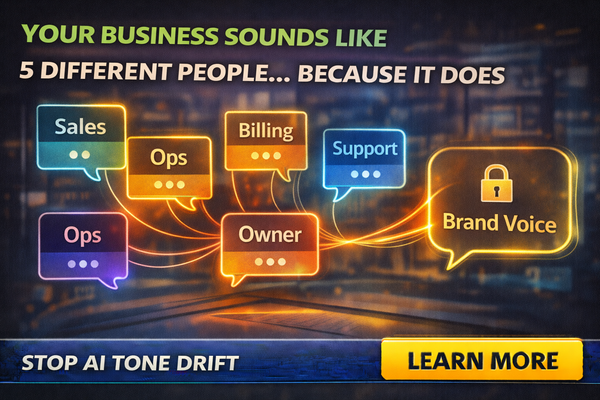
- Brand voice chaos (every reply sounds different)
- Confident-wrong mistakes (AI drafts that sound sure, but are incorrect)
- Workflow loss (the “good prompts” disappear when an employee leaves)
- No audit trail (you cannot answer “who sent this and why?”)
And if you serve the public, the trust hit is real. One weird, robotic, overconfident email can damage a relationship you worked hard to build.
“But the AI vendor says it’s private”
Here’s the awkward truth: you should not build your confidentiality strategy on vibes.
The FTC has explicitly warned AI companies to uphold privacy and confidentiality commitments, noting that AI services often have strong incentives to ingest more data, and that can conflict with privacy obligations.
That does not mean “never use AI.”
It means you need a basic plan for what tools are allowed, what data can be used, and how your team should handle sensitive information.
The good news: you can fix shadow AI without becoming the AI police
Most owners try one of two approaches:
- Ban AI completely.
- Ignore it and hope for the best.
Both fail.
The practical approach is a third option:
Approve a small set of tools, define safe use, and give your team a better path than random apps.
NIST’s AI Risk Management Framework materials, including the Generative AI Profile, are designed to help organizations identify and manage unique risks posed by generative AI.
You do not need a formal governance program like a big corporation, but you can borrow the mindset: visibility, guardrails, accountability.
The 60-minute “Shadow AI Cleanup” plan for small businesses
Here’s a realistic plan that works for teams under 10 people.
Make an “Approved Tools” list that is short
Pick one or two tools your team can use for writing, summarizing, and drafting. The goal is consistency and control, not “every tool under the sun.”
If you already live in Microsoft 365, it’s worth knowing that Microsoft states that for Microsoft 365 Copilot, prompts and responses and data accessed through Microsoft Graph are not used to train the underlying foundation models.
That type of clarity is what you want when choosing tools.
Create a “Do Not Paste” rule
One rule that prevents most problems:
Do not paste anything that includes:
- full client names + personal details
- policy numbers or financial info
- invoices and payment data
- passwords, access codes, or screenshots with credentials
- contracts in full, unless the tool is approved for it
Add a “Redact First” habit
Teach this one move:
- “Client Name” becomes “Client A”
- addresses become “Address A”
- policy numbers become “Policy ID”
- invoice totals become “Amount”
It takes 20 seconds and prevents a lot of regret.
Ship a “Prompt Pack” so people do not freestyle
Shadow AI gets worse when people improvise. Give them 5–10 approved prompts:
- summarize thread and list action items
- draft a reply in our tone
- rewrite this service description
- follow-up template that sounds human
- proposal outline
When you provide a better system, people stop searching for random shortcuts.
Train for 20 minutes, not two hours
Show two examples:
- “bad use” (pasted sensitive info)
- “good use” (redacted, structured)
Make it practical, not scary.
Add offboarding to your checklist
If an employee leaves, you should revoke access to approved tools and shared prompt libraries the same day. Shadow AI often lives in personal accounts, which is exactly why standardization matters.
The point is not control. It’s consistency.
If you are thinking, “This feels like overkill for a tiny team,” consider the alternative:
A tiny team has less margin for mistakes.
One bad message can cost a deal. One data slip can cost trust. One weird AI reply can make you look careless.
Final Thought
Shadow AI is already in most businesses. The question is whether you will manage it, or let it manage you.
If you want help choosing approved tools, setting safe-use rules, and building a prompt pack your team will actually follow, Managed Nerds can set up practical AI training and guardrails for small businesses without slowing anyone down.
Subscribe to stay update with the latest Small Business AI Tips