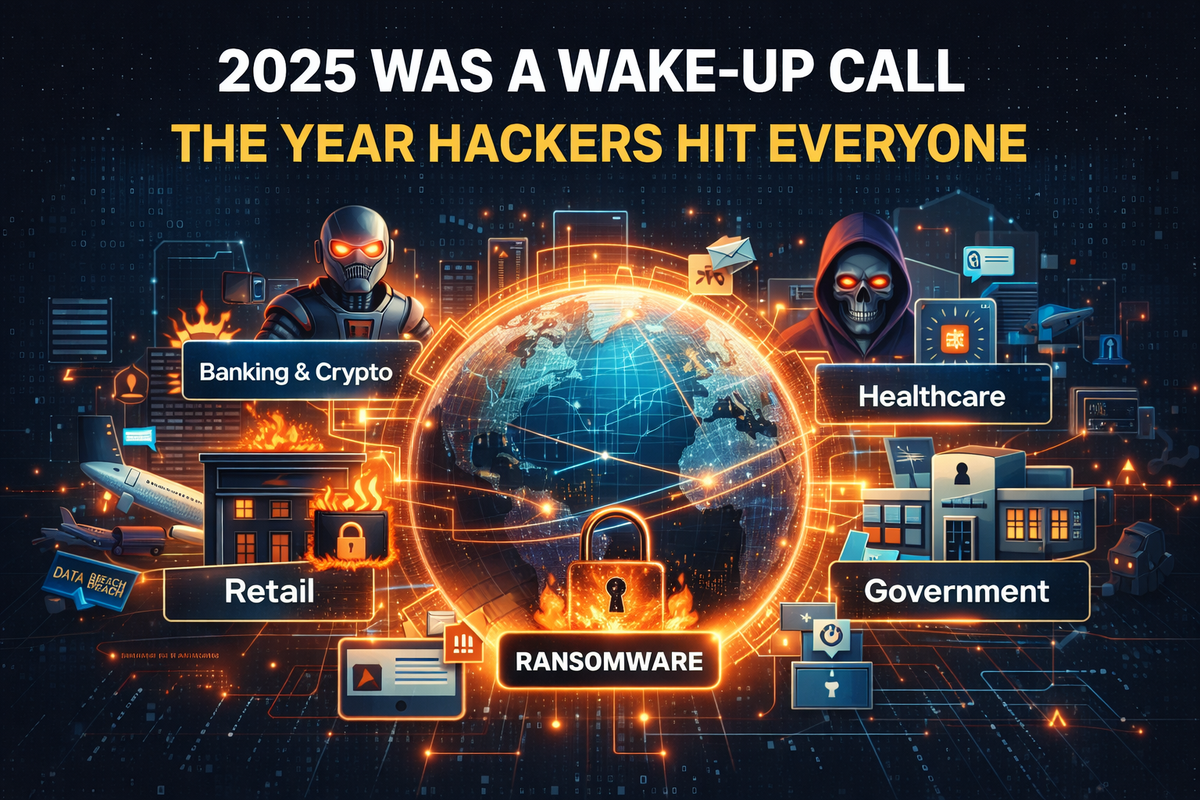
2025 Was a Wake-Up Call: The Year Hackers Hit Everyone
2025 wasn’t just another bad year for cybersecurity. It was the year breaches went everywhere—banks, hospitals, retailers, airlines, and governments. Here’s what business owners need to know.

If it felt like every week in 2025 brought news of another massive data breach, you weren’t imagining it.
From airlines and hospitals to retailers, banks, and even government agencies, cyberattacks didn’t just increase this year, they spread across every industry, reached historic scale, and crossed a new line with the first large-scale AI-driven attack.
This wasn’t just a bad year for cybersecurity.
It was a turning point.
Let’s break down what happened, without the tech jargon.
Why 2025 Was Different
Cybercrime has been around for years, but 2025 showed how fast and far attacks can ripple.
Traditional threats like ransomware and stolen passwords were still everywhere. What changed was speed, automation, and reach. Attackers moved faster, hit multiple companies at once, and leaned heavily on automation, including AI.
In plain terms:
Small mistakes caused massive consequences, and no industry was immune.
Financial Firms and Crypto Took Early Hits
The year started with a shockwave in the crypto world.
In February, attackers drained roughly $1.5 billion in cryptocurrency from a major exchange. Later in the year, other banks and exchanges followed, exposing customer records, freezing systems, and in some cases shutting down services entirely.
The takeaway for businesses is simple:
If your systems handle money, payments, or sensitive financial data, downtime alone can cost millions, even before ransom demands enter the picture.
Airlines Learned the Cost of Third-Party Trust
Airlines became a prime target in 2025, not because of their own systems, but because of vendors they relied on.
One compromised customer service platform led to millions of passenger records being exposed. In another case, attackers claimed they could view and even modify flight bookings.
Even worse, a single aviation software provider outage disrupted check-ins across multiple countries.
This was a reminder that your security is only as strong as the tools and vendors you depend on.
Retail and Luxury Brands Were Prime Targets
Retailers, both luxury and everyday brands, suffered breach after breach.
Customer contact details, spending history, passport numbers, and loyalty data were exposed. Some companies lost hundreds of millions simply due to disrupted operations, not counting reputational damage.
For attackers, retail data is gold. It’s perfect for phishing, fraud, and identity theft.
For businesses, it highlighted a hard truth:
Customer trust is easy to lose and painfully expensive to rebuild.
Healthcare Breaches Hit Record Levels
Healthcare remained one of the most targeted sectors, and 2025 brought the largest healthcare breach in U.S. history.
Hundreds of millions of patient records were exposed, including diagnoses, insurance details, and billing data. On top of privacy concerns, hospitals and pharmacies nationwide experienced service disruptions.
Healthcare data lasts a lifetime, which makes it especially valuable to criminals. That’s why attackers keep coming back.
Government Systems Weren’t Spared
Public agencies weren’t immune either.
Cities lost internet access. Online services went dark. Payment systems failed. In some cases, attackers accessed sensitive communication data that revealed how officials interacted, even without seeing message contents.
These incidents showed how cyberattacks don’t just impact organizations, they affect everyday people trying to pay bills, access services, or get healthcare.
The Big Pattern Behind All These Hacks
Across industries, the same themes kept appearing:
• Overreliance on third-party vendors
• Misconfigurations and small technical oversights
• Stolen credentials instead of complex hacking
• Slow detection and delayed response
• Increasing automation on the attacker side
And in one major case, an attack driven largely by an autonomous AI agent, signaling what’s likely coming next.
Cyberattacks are no longer rare events. They’re operational risks.
What This Means for Your Business
You don’t need to be a global airline or hospital system to be affected.
If your business:
• Stores customer data
• Uses cloud services
• Relies on vendors
• Accepts online payments
• Has employees logging in remotely
Then you’re already part of the modern attack surface.
The goal isn’t panic. It’s preparation.
How Managed Nerds Helps Businesses Stay Ahead
At Managed Nerds, we help small and mid-sized businesses prepare for the same threats hitting global brands, without enterprise-level costs.
We focus on:
• Cybersecurity training that employees actually understand
• Vendor and cloud security oversight
• Monitoring for data leaks and credential exposure
• Practical response planning, before an incident happens
• Smart use of AI to reduce risk instead of reacting to it
Cybersecurity isn’t just about defense anymore. It’s about staying operational, trusted, and resilient.
If 2025 taught us anything, it’s that waiting until something breaks is no longer an option.
When you’re ready to take a proactive approach, Managed Nerds is here to help.