Lead Magnets for Small Businesses: What Actually Gets Signups
Want to build an email list without sounding spammy? Here are simple lead magnet ideas small businesses can use to turn website visitors into future leads.

Blog #47
SEO Title
Lead Magnets for Small Businesses: What Actually Gets Signups
Meta Description
Most “subscribe to our newsletter” boxes get ignored. Learn how small businesses can create simple lead magnets that build email lists and drive leads.
Blog Excerpt
Want to build an email list without sounding spammy? Here are simple lead magnet ideas small businesses can use to turn website visitors into future leads.
Blog Image Prompt
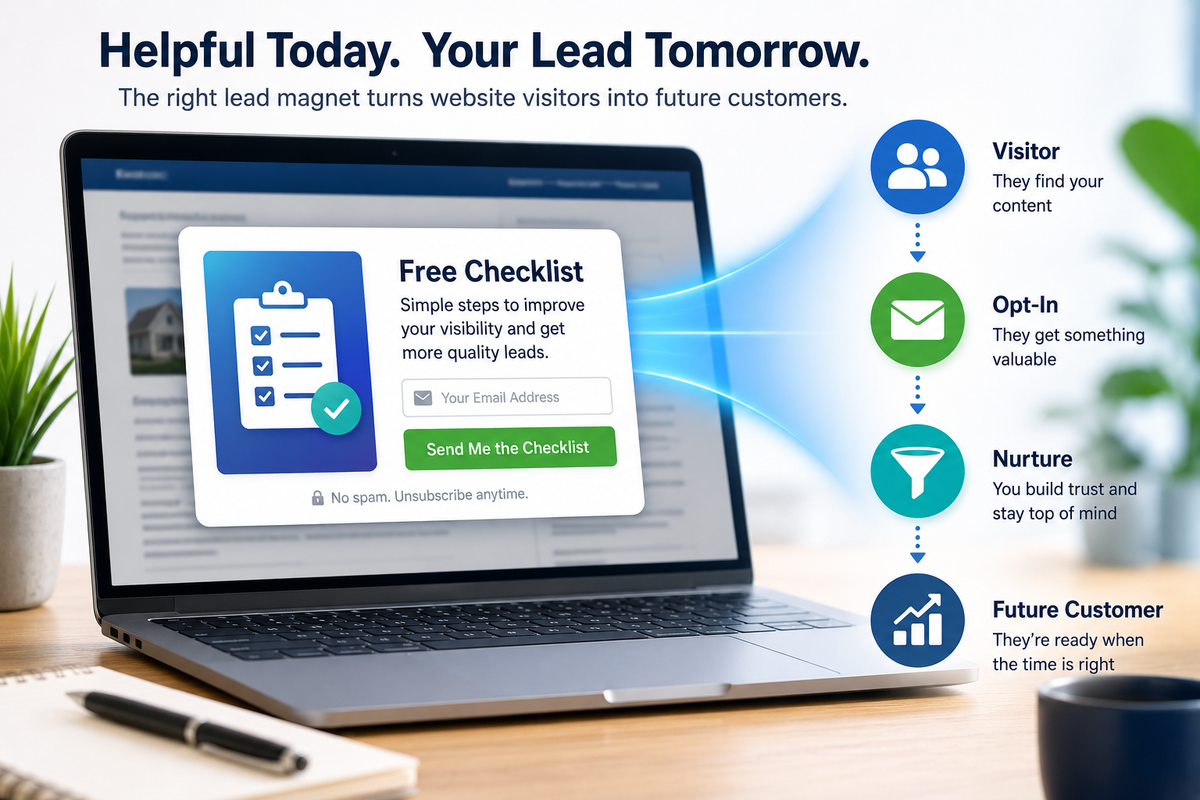
A clean 16:9 blog image showing a small business website offering a helpful downloadable checklist, with glowing email signup cards flowing into a secure customer hub. Simple modern ad-tech style, soft blue and green tones, no logos, no readable text.
Lead Magnets for Small Businesses: What Actually Gets Signups
If your website says “Subscribe to our newsletter,” and nobody subscribes, don’t take it personally.
Most people do not wake up excited to join another newsletter.
They need a reason.
That reason is called a lead magnet.
A lead magnet is something useful you give in exchange for a visitor’s contact information, usually an email address. It could be a checklist, guide, pricing worksheet, audit, template, or short resource that helps them solve a small problem.
The key word is useful.
Not fluffy.
Not generic.
Not “join our list for updates.”
Useful.
Why lead magnets matter now
In the last AD-tech blog, we talked about first-party data, which is the customer and lead information your business collects directly.
A lead magnet is one of the simplest ways to start building that first-party data.
Instead of relying only on:
- social media reach
- paid ads
- Google rankings
- platform algorithms
…you start building an audience you can follow up with directly.
That matters because not every visitor is ready to buy today.
Some are comparing.
Some are researching.
Some are waiting for the right time.
Some need to trust you first.
A good lead magnet gives them a low-pressure next step.
The problem with “subscribe to our newsletter”
“Subscribe to our newsletter” is vague.
It does not tell the visitor:
- what they get
- why it matters
- how it helps them
- whether it is worth giving up their email
Most small businesses need a more specific offer.
Instead of:
“Subscribe for updates”
Try:
“Get the 10-point checklist before hiring an SEO company.”
That is specific.
It promises a result.
It helps the visitor make a better decision.
What makes a good lead magnet?
A good lead magnet should be:
Specific
It should solve one small problem.
Bad:
“Small Business Marketing Guide”
Better:
“7 Questions to Ask Before Hiring an SEO Company”
Quick to consume
People are busy. A 40-page ebook sounds like homework.
Better options:
- 1-page checklist
- short guide
- worksheet
- mini audit
- template
- 5-minute video
Connected to your service
Your lead magnet should naturally lead to what you sell.
If you offer SEO services, your lead magnet might be:
- SEO audit checklist
- Google Business Profile checklist
- website conversion checklist
- “Are your ads wasting money?” worksheet
If your lead magnet attracts people who would never buy from you, it is the wrong magnet.
Easy to deliver
Do not overcomplicate this.
A simple PDF, automated email, or thank-you page is enough to start.
10 lead magnet ideas for small businesses
Here are practical options that work well for service businesses.
1) Checklist
This is the easiest place to start.
Examples:
- “The Google Business Profile Cleanup Checklist”
- “The Website Lead Form Checklist”
- “The 10-Minute Google Ads Waste Check”
- “The Small Business SEO Readiness Checklist”
People like checklists because they are fast and actionable.
2) Pricing guide
Cost questions get attention because they reduce uncertainty.
Examples:
- “What Should Small Business SEO Cost?”
- “Google Ads Starter Budget Guide”
- “Website Fixes: What to Budget First”
You do not have to give exact pricing if it varies. You can explain ranges, factors, and what affects the final cost.
3) Audit worksheet
This is especially strong for marketing, IT, SEO, websites, and business services.
Examples:
- “Website Speed Self-Audit”
- “Lead Quality Scorecard”
- “Is Your Website Ready for AI Search?”
- “SEO vs Ads: 90-Day Planning Worksheet”
An audit worksheet helps people diagnose their problem, then naturally points them toward help.
4) Template
Templates are useful because they save time.
Examples:
- review request script
- follow-up text sequence
- UTM naming template
- content calendar template
- ad creative rotation template
Templates are also easy to repurpose into blogs, social posts, and emails.
5) Quick video training
A short video can work well if your audience prefers watching over reading.
Examples:
- “How to Check If Your Google Business Profile Is Hurting Leads”
- “How to Spot Wasted Google Ads Spend in 10 Minutes”
- “How to Turn One Blog Into 10 Pieces of Content”
Keep it short. Five to eight minutes is plenty.
6) Mini email course
This is useful when your topic needs a little education.
Example:
“5 Days to a Cleaner Small Business Marketing System”
Day 1: Fix tracking
Day 2: Clean up GBP
Day 3: Improve your landing page
Day 4: Build proof
Day 5: Review leads
This keeps your business in their inbox without being pushy.
7) Scorecard
People like finding out where they stand.
Examples:
- “Lead Quality Scorecard”
- “SEO Readiness Scorecard”
- “Website Trust Scorecard”
- “Ad Waste Scorecard”
A scorecard creates a natural next step because once someone sees the score, they want to improve it.
8) Local checklist
Local lead magnets can be powerful because they feel more relevant.
Examples:
- “Augusta Small Business Google Profile Checklist”
- “Evans Service Business SEO Starter Checklist”
- “Columbia County Local Visibility Checklist”
This is especially helpful for small business SEO because local relevance matters.
9) Decision guide
This helps people who are comparing options.
Examples:
- “SEO vs Ads: Which Should You Start With?”
- “Should You Boost Posts or Run Real Ads?”
- “Local Services Ads vs Google Search Ads”
- “Do You Need a New Website or Better Landing Pages?”
Decision guides attract people who are actively thinking about buying.
10) “Before you hire” guide
This builds trust fast.
Examples:
- “Before You Hire an SEO Company, Ask These 7 Questions”
- “Before You Spend on Ads, Check These 5 Things”
- “Before You Redesign Your Website, Fix This First”
This positions you as helpful, not desperate.
Where to place a lead magnet
Do not hide it at the bottom of your website.
Place it where the topic matches the visitor’s intent.
Good placements:
- related blog posts
- service pages
- exit-intent popup (use carefully)
- sidebar or mid-blog callout
- email signature
- social media bio link
- Google Business Profile post
- retargeting ad
Example:
If someone is reading a blog about low-quality leads, offer:
“Download the Lead Quality Filter Checklist.”
That is much better than:
“Subscribe to our newsletter.”
What happens after someone signs up?
This is where many businesses drop the ball.
A lead magnet should trigger a simple follow-up.
Email 1: Deliver the resource
Send the checklist, guide, or template immediately.
Keep it short.
Email 2: Give one extra tip
The next day, send one practical tip related to the resource.
Email 3: Show proof
Share a quick example, result, or testimonial.
Email 4: Offer a soft next step
Invite them to:
- ask a question
- request an audit
- book a short call
- read a related guide
This turns a download into a relationship.
How to track whether it works
Track:
- landing page visits
- signup rate
- email open rate
- replies
- booked calls
- lead quality
Use UTM links when promoting your lead magnet on social, email, GBP, or ads.
That way you know which channel is actually building your list.
The biggest mistakes to avoid
Making the lead magnet too broad
“Ultimate Guide to Marketing” sounds big, but it is not specific enough.
Asking for too much information
For a simple checklist, name and email may be enough.
Do not ask for a phone number unless the offer justifies it.
Creating it once and never promoting it
A lead magnet is not useful if nobody sees it.
Promote it repeatedly.
Not following up
A download without follow-up is a missed opportunity.
Using a lead magnet that attracts the wrong audience
If your freebie attracts people who only want free help and never buy, adjust the topic.
The bottom line
A good lead magnet helps small businesses turn anonymous visitors into future leads.
It does not need to be fancy.
It needs to be useful, specific, easy to consume, and connected to your service.
Start with one:
- checklist
- scorecard
- pricing guide
- audit worksheet
- template
Then place it on your best blog posts and service pages.
Need help creating lead magnets that support small business SEO and bring in better leads? Managed Nerds offers practical SEO and marketing support to help you turn website traffic into email subscribers, follow-up opportunities, and real customer conversations.
Thank you for reading. If you’d like more small business SEO tips, subscribe for updates.