
Your Reviews Are 5 Stars… So Why Are You Still Losing on Google?
If you have 5-star reviews but your competitor still outranks you, you are not crazy. Reviews are only part of local SEO. Here’s what Google looks at next.

You did the hard part.
You asked for reviews. You earned the reviews. You’re sitting on a clean row of five-star ratings that should be printing money.
And yet the calls are not matching the stars.
Welcome to one of the most confusing truths in local SEO:
Reviews are powerful, but reviews are not the whole ranking system.
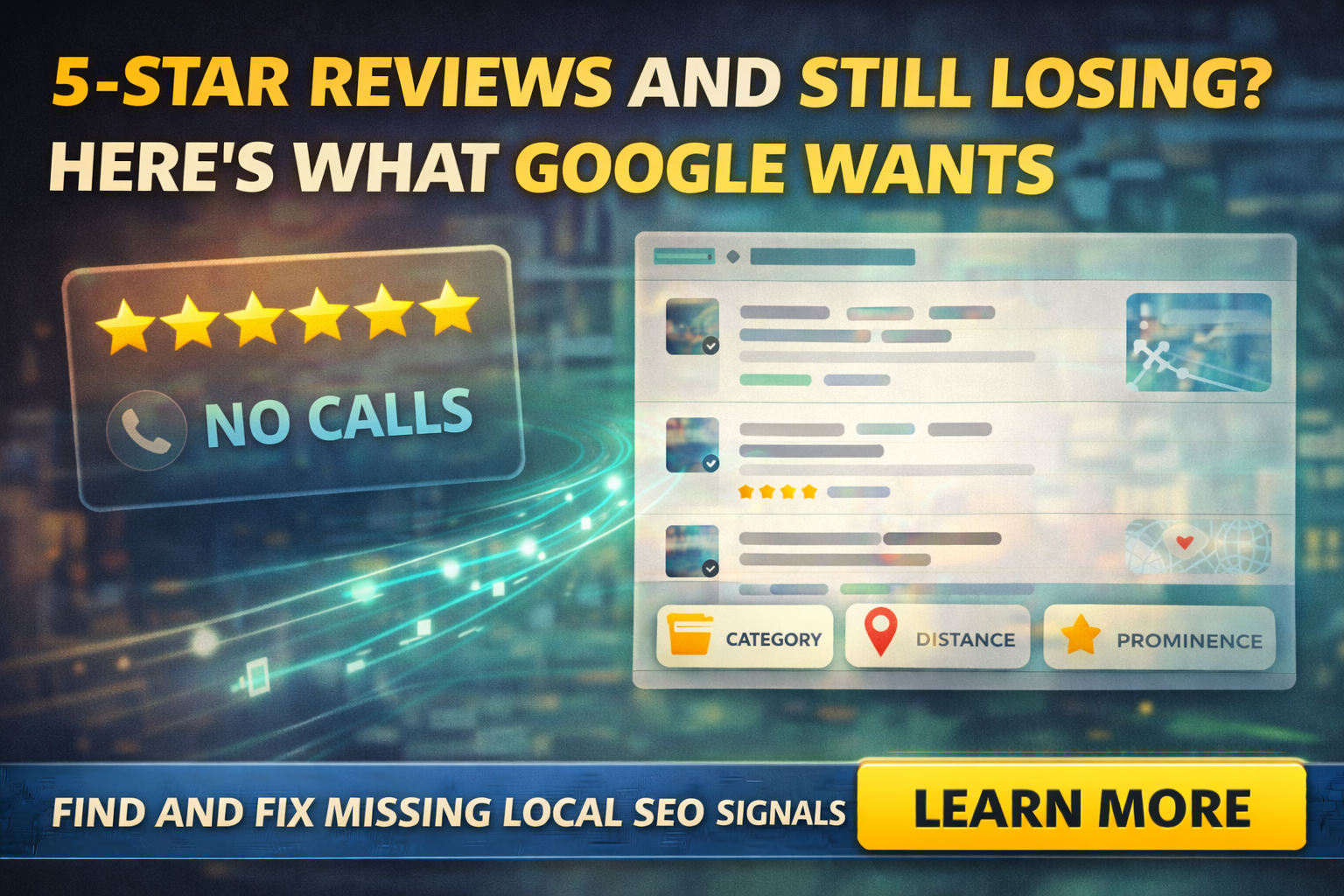
Google itself explains that local results are mainly based on relevance, distance, and prominence (sometimes described as popularity).
Reviews can support prominence, but they cannot fix relevance problems, distance limitations, or a listing that is unclear about what you actually do.
So if your reviews are great and you’re still losing, here’s what’s probably happening.
The tabloid truth: Google isn’t “ignoring” your reviews, it’s just not impressed enough
If you’re in a competitive area, lots of businesses have decent reviews. So Google uses more signals to decide who gets the top slots for a specific search at a specific moment.
Think of reviews like a strong engine.
If your steering wheel is pointed the wrong direction, the engine won’t get you where you want to go.
Why 5-star reviews don’t guarantee rankings
Let’s break it down using Google’s three factors.
Relevance: are you an obvious match for the search?
If someone searches “roof repair Evans GA” or “home inspector near me” and your profile is vague, Google has less confidence showing you. Your reviews don’t matter if Google can’t confidently connect your business to the search.
Distance: are you close enough to the searcher?
You can’t control where the searcher is standing. If a competitor is closer, they may get preference.
Prominence: are you well-known and trusted?
Reviews help here, but prominence also includes broader signals like overall web presence, citations, and consistency.
Google literally says it: relevance, distance, and popularity/prominence together help it find the best match.
So if you’re losing with great reviews, it usually means you’re weak in relevance signals, or you’re losing on distance, or your prominence is incomplete.
The most common reason: your category and services are “close enough” but not perfect
This is where a lot of small businesses quietly sabotage themselves.
Google’s guidelines tell businesses to choose the fewest categories needed to describe the core business.
If your primary category is slightly off, you can rank for the wrong things, or not rank well for the right things.
Then there’s the services list. If your services are missing, generic, or not aligned with how people search, you’re leaving relevance on the table.
Owner translation: Google can’t confidently match you if you won’t clearly label yourself.
The second reason: your website is not backing up your listing
A strong Business Profile paired with a weak website is like a great sign on an empty building.
If your competitor’s website has:
- clear service pages
- strong location relevance (without spam)
- FAQs that match real customer questions
- proof photos and clear CTAs
Google has more confidence sending traffic there.
This is where it gets annoying: you might be doing reviews right while your competitor is doing the “boring structure” right.
And the boring structure wins.
The third reason: your competitors are “more prominent” online, even if they’re not better
Prominence can include signals like mentions across the web, consistent business info, directory accuracy, and overall online footprint.
If your business name, address/service area, and phone don’t match everywhere, or if you have duplicates floating around, your “prominence signal” gets noisy.
Google’s guidelines emphasize representing your business consistently and keeping address or service area accurate.
Your reviews can be flawless, but if the rest of your business presence looks messy, you’re harder to trust.
The fourth reason: your reviews are great, but your profile looks inactive
Customers click listings that feel alive.
If your competitor has:
- fresh photos
- recent updates
- answered Q&A
- quick review responses
They often get more engagement. That can help conversions even if rankings are similar.
And conversion matters because it decides whether rankings turn into calls.
A quick warning: Google is cracking down on review fraud
Some businesses try to “fix” this problem the wrong way.
Google has faced regulatory pressure and has agreed to stronger measures to detect and remove fake reviews in the UK, including penalties for businesses involved in manipulation.
Even if you’re not in the UK, the direction is clear: review manipulation is a bad long-term play. Build legit reviews, steady, from real customers.
The “5-Star But Losing” checklist that actually fixes it
If you want a practical plan, here’s where to focus next:
- Tighten your primary category and keep categories focused
- Expand services with real-world phrasing people search for
- Add proof photos consistently
- Post occasional updates so the profile looks active
- Make sure your website has strong service pages that match your top services
- Clean up inconsistent listings and duplicates (name, phone, service area)
- Respond to reviews like a human, not a script
Final Thought
If you have 5-star reviews and you’re still losing, you don’t need to “try harder.” You need to strengthen the signals reviews can’t replace: relevance clarity, website support, and prominence consistency.
If you want help diagnosing what’s missing and fixing it fast, Managed Nerds can audit your Business Profile + website together and build a practical local SEO plan for tiny teams that want calls, not confusion.
Subscribe for more small business SEO tips.