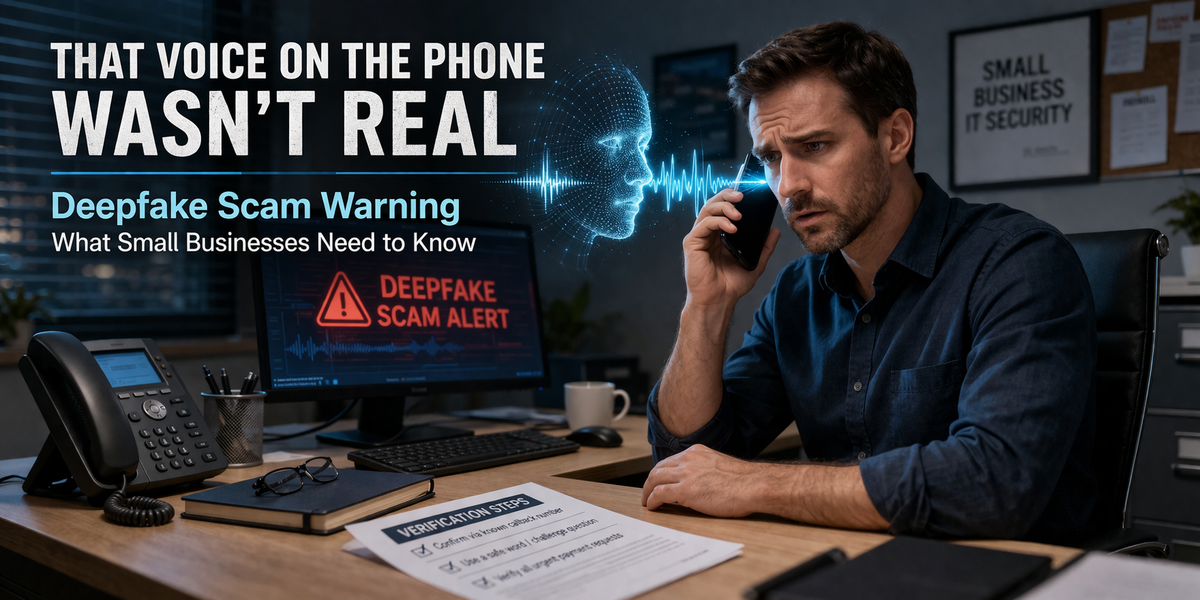
That Voice on the Phone Sounded Real… Until It Wasn’t
Deepfake phone scams are no longer just a strange AI headline. They are becoming a real risk for small businesses that rely on trust, quick decisions, and familiar voices. Here’s what business owners need to know and how to respond.

The Deepfake Scam Small Business Owners Need to Take Seriously
It used to be easier to trust a familiar voice.
If someone sounded like your employee, your business partner, a vendor, or even a family member, most people would not think twice. But that is exactly what scammers are counting on now.
A new Cybernews report says one in four Americans say they received a deepfake phone call in the past year, and Americans reported getting almost ten deepfake calls per week on average. Even more unsettling, 24% said they are not sure they could reliably tell the difference between a real person and a machine on the phone.
That is not just a personal problem. For small businesses, it is becoming a real-world security issue.
Why This Matters to Small Business Owners
Small businesses run on trust.
You trust your team, your vendors, your accountant, your clients, and the people calling with urgent questions or last-minute requests. Deepfake voice scams are dangerous because they exploit that trust. Criminals have long impersonated relatives, coworkers, or authority figures to pressure victims into sending money, but AI voice cloning is making those scams more believable, easier to scale, and harder to spot.
A scammer does not need a perfect imitation. They just need a voice that sounds convincing long enough to create panic.
That could mean a fake employee asking for a rush payment, a fake manager demanding gift cards, or a fake vendor saying banking information has changed and money needs to be sent right away. The old scam formula is still there, but now the delivery sounds a lot more real.
How These Scams Work
This is where the story gets uncomfortable.
According to the article, voice samples can be collected from social media, old recordings, or even robocalls designed to capture speech. Attackers can then clone a voice and use AI agents to run scams at scale, including real-time conversations.
Think about how often business owners and employees speak publicly now. Videos on social media, voicemail greetings, webinars, sales calls, podcast appearances, even customer service recordings. That is a lot of material floating around for bad actors to work with.
The issue is not that every fake call will be flawless. It is that some will be just believable enough to make someone act before they stop and think.
The “Safe Word” Idea Is Simple, But the Lesson Is Bigger
Cybersecurity experts quoted in the report recommend using a safe word, phrase, or question to verify identity when a call feels suspicious. The idea is simple: if someone calls in distress or asks for urgent help, you ask for the agreed phrase before doing anything. Experts also stress that awareness matters, and that hanging up can kill the scam because the attacker loses momentum.
For businesses, the lesson is bigger than just picking a word.
You may not need a literal family-style safe word, but you do need a simple internal verification process for high-risk requests.
What a “Business Safe Word” Can Look Like
For a small business, that can be as straightforward as creating a few rules everyone follows:
Verify urgent money requests another way
If anyone calls asking for a wire transfer, payroll update, gift card purchase, password reset, or banking change, require a second step before taking action.
Use a known callback number
Do not trust the number that just called you. The experts in the article recommend verifying the caller through another channel, such as messaging them elsewhere or calling them back on a known number. One expert also warned that scammers can rig callback numbers, so it is safer to use contact information you already trust.
Ask an internal challenge question
That could be a client detail, project status, invoice reference, or another piece of information an outsider is unlikely to know.
Slow the moment down
The article stresses that these scams almost always involve time pressure. That pressure is not random, it is the tactic. Scammers want people moving too fast to think clearly.
The Biggest Red Flag Is Urgency
This is the part small business owners should drill into their teams.
If the message is, “Do this right now,” “Don’t tell anyone,” or “I need money immediately,” that is your cue to pause. The experts quoted in the article say these scams often rely on panic, emotional distress, and pressure to force quick decisions. They also warn that dealing with deepfake scams now requires what one expert called “unlearning trust.”
That sounds harsh, but it is true.
A real employee, real vendor, or real client can survive a two-minute verification step. A scam usually cannot.
Why This Threat Is Growing So Fast
Cybernews cites research from Hiya, which surveyed 12,000 consumers across the US, UK, Canada, France, Germany, and Spain. The report also notes that seniors are particularly vulnerable, losing an average of $1,298 on scams, and points to Deloitte’s estimate that generative AI could enable fraud losses of up to $40 billion by 2027 in the US alone.
For a small business, the damage is not only financial.
It can also mean:
- disrupted operations
- compromised accounts
- confused staff
- broken trust
- embarrassing client-facing mistakes
That is why this is more than just another strange AI headline. It is a practical business risk that can hit ordinary companies, not just giant corporations.
What Small Businesses Should Do Right Now
You do not need to become a cybersecurity expert overnight, but you do need a process.
Start here:
- Train employees to question urgent phone requests
- Require a second verification step for payments and account changes
- Do not treat a familiar voice as proof of identity
- Use known contact information, not the number provided during the call
- Talk about deepfake scams before your team faces one in the heat of the moment
The article makes one thing very clear: people should not be expected to outsmart AI on instinct alone. Awareness and process matter more than gut feeling now.
Final Thought
Deepfake scams work because they target one of the most natural parts of doing business: trust.
When a voice sounds familiar, people react fast. That is exactly why small businesses need to build simple verification habits now, before one convincing phone call turns into lost money, exposed accounts, or a stressful mess that could have been avoided.
Need help making your business a little harder to fool? Managed Nerds helps small businesses strengthen the technology side of everyday operations with practical IT support, cybersecurity guidance, system monitoring, and business tech solutions that keep things running more safely behind the scenes. Whether it is helping you tighten internal processes, protect accounts and devices, or make sure your team is using smarter safeguards, the goal is simple: reduce risk without adding confusion.