The $1.4 Million Scam That Started With Trust. What Small Businesses Should Learn.
A $1.4 million Telegram scam proves cybercriminals still rely on trust, not just technology. Learn how small businesses can recognize and prevent social engineering attacks.

Most cybercriminals don't begin by attacking computers.
They begin by attacking trust.
A recent case involving a cryptocurrency influencer is another reminder that today's cybercriminals often rely on deception, impersonation, and social engineering rather than sophisticated hacking.
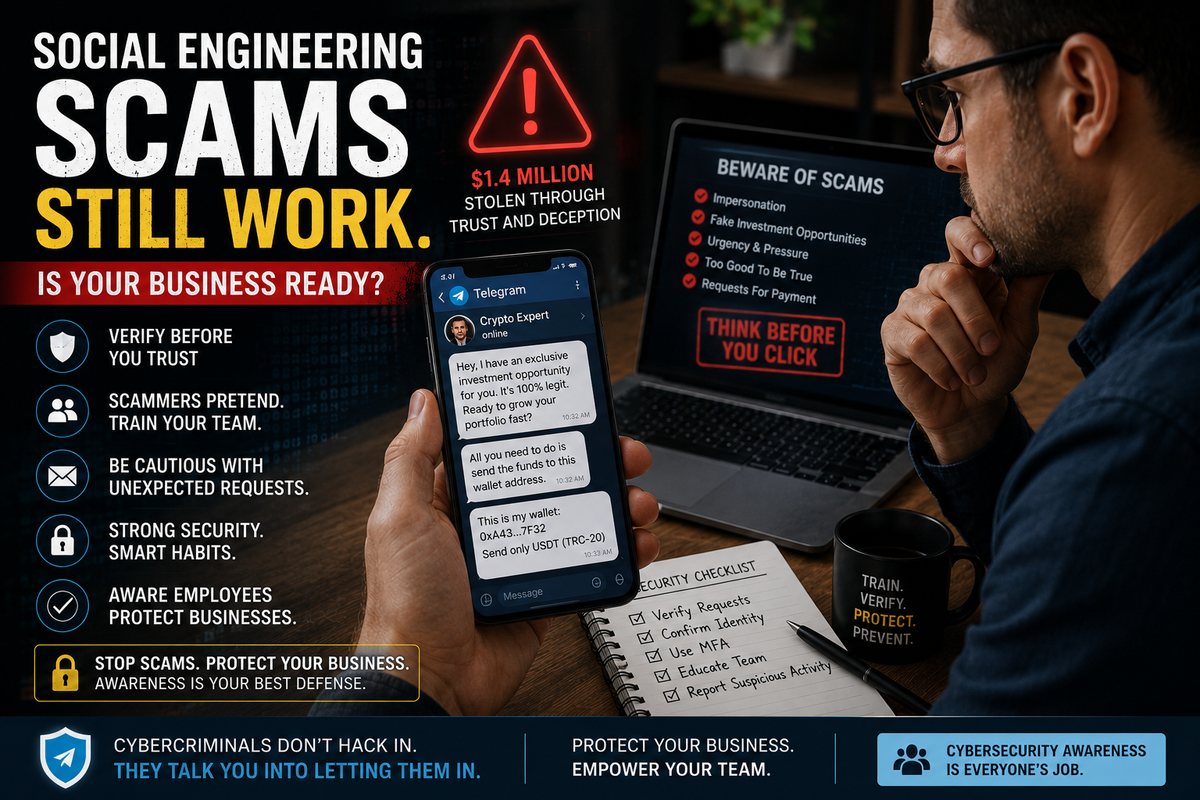
According to reports, a man was sentenced to prison after orchestrating a scheme that stole approximately $1.4 million by impersonating a well-known cryptocurrency influencer on Telegram. Victims believed they were communicating with someone they trusted, when in reality they were speaking with a scammer.
While the scam targeted cryptocurrency investors, the tactics used are becoming increasingly common across every industry—including small businesses.
What Happened?
According to investigators, the scammer posed as a trusted cryptocurrency influencer on Telegram and convinced victims to transfer funds under false pretenses.
Rather than exploiting software vulnerabilities or breaking into computer systems, the attacker exploited something much easier:
People's trust.
The victims believed they were interacting with a legitimate individual, making the scam appear authentic.
It's another example of why social engineering continues to be one of the most successful forms of cybercrime.
Why This Matters for Small Businesses
You may not run a cryptocurrency business.
But attackers use these same tactics every day against businesses like yours.
Instead of pretending to be a crypto influencer, they may impersonate:
- Your bank
- A customer
- A vendor
- Your accountant
- A shipping company
- Your IT provider
- Even your own employees
The goal is always the same:
Build enough trust to convince someone to take an action they normally wouldn't.
Social Engineering Is Becoming More Convincing
Scammers have become remarkably good at making fake communications look legitimate.
Today's attacks often include:
- Professional writing
- Company branding
- Publicly available information
- AI-generated messages
- Fake social media profiles
- Spoofed email addresses
- Familiar names and profile photos
Some attacks involve weeks of conversation before any money or sensitive information is requested.
That patience makes them even more dangerous.
The Cost Can Be More Than Money
For small businesses, a successful impersonation attack can lead to:
Fraudulent Payments
Employees may unknowingly send payments to criminals.
Stolen Credentials
Fake login pages can capture usernames and passwords.
Customer Data Exposure
Sensitive business information may fall into the wrong hands.
Reputation Damage
Customers expect businesses to verify who they're communicating with.
Operational Disruption
Recovering from fraud often takes far longer than the initial attack.
Many small businesses don't realize they've been targeted until the damage has already been done.
Your Employees Are the First Line of Defense
Technology plays an important role in cybersecurity.
But people remain your strongest defense—or your biggest vulnerability.
Employees should know how to:
- Verify unexpected payment requests
- Recognize impersonation attempts
- Confirm identity through a second communication method
- Spot phishing messages
- Report suspicious communications immediately
One well-trained employee can stop an attack before it ever reaches your systems.
Verify Before You Trust
One of the simplest cybersecurity habits any business can adopt is verification.
If someone requests:
- A payment
- Sensitive information
- Passwords
- Login credentials
- Banking changes
- Gift cards
- Customer records
Take a moment to verify the request using a trusted communication method.
A quick phone call could prevent thousands of dollars in losses.
How Managed Nerds Helps Businesses Reduce Social Engineering Risks
Many cybersecurity incidents begin long before malware is involved.
They begin with a conversation.
That's why Managed Nerds helps small businesses strengthen both their technology and their people through:
- Cybersecurity awareness training
- Social engineering and phishing education
- Managed IT services
- Email security solutions
- Multi-factor authentication implementation
- Account protection
- Ongoing security monitoring
- Incident response guidance
The goal isn't just to block attacks.
It's to help employees recognize them before they succeed.
Final Thought
The Telegram scam that resulted in $1.4 million in stolen funds is another reminder that cybercriminals don't always need advanced hacking skills.
Sometimes they simply need someone willing to believe they're legitimate.
As scams become more convincing—and AI makes impersonation even easier—verification, employee awareness, and strong security habits become more valuable than ever.
Technology can help protect your business.
But informed employees remain one of your best defenses.
Need Help Protecting Your Business From Modern Scams?
Whether it's phishing, impersonation, business email compromise, or employee cybersecurity awareness, Managed Nerds helps small businesses build practical defenses against today's most common cyber threats.
From cybersecurity training to managed IT services and proactive security monitoring, we help businesses stay prepared before attackers have the chance to succeed.
Want More Simple Tech Tips Like This?
Subscribe for practical technology and cybersecurity insights designed specifically for small business owners who want to stay informed, protected, and one step ahead of evolving cyber threats.