Can AI Answer Your Phone Without Losing Customers?
Missed calls cost small businesses real leads. Here’s how AI phone assistants can help answer, route, summarize, and follow up without frustrating customers.

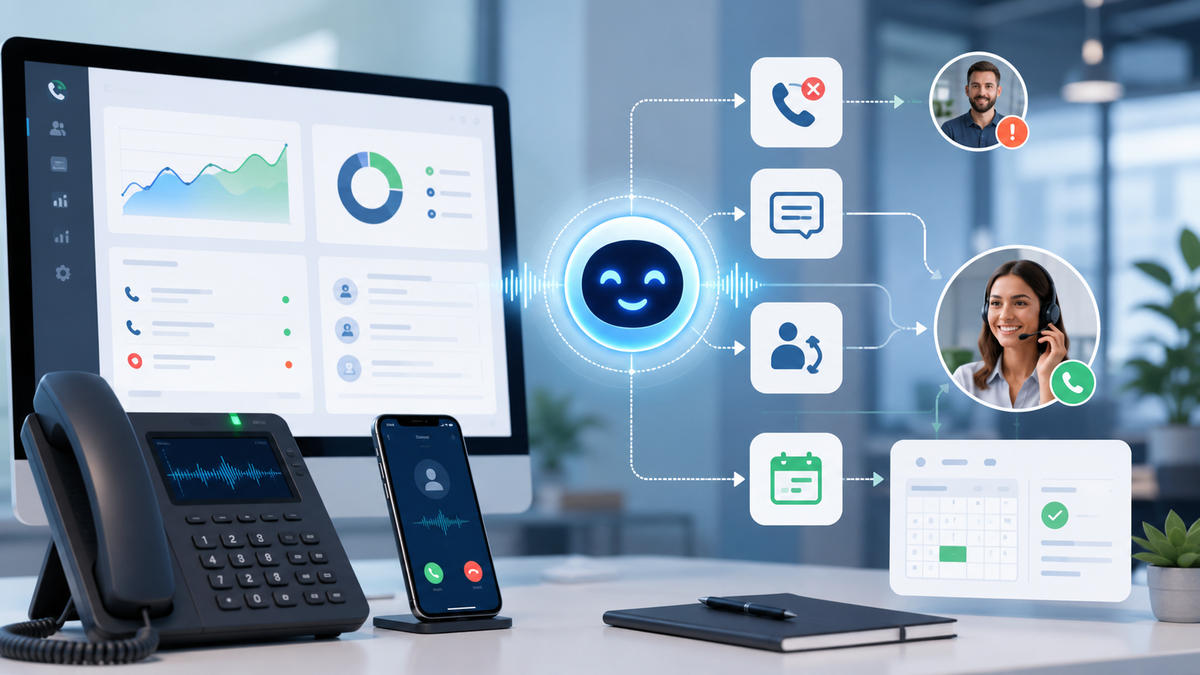
For a lot of small businesses, the phone is still where the money happens.
A customer calls because they need help.
You miss the call because you are on a job, in a meeting, driving, or helping another customer.
They call the next business.
You never even knew how close you were to getting the job.
That is the real cost of missed calls.
And it is why AI phone assistants are becoming more interesting for small businesses.
Not because every business needs a robot receptionist.
Not because AI should replace human relationships.
But because AI may be able to catch the calls you would have missed, collect the basic details, and help you respond faster.
Google Cloud’s 2026 AI agent trends report says AI agents are moving from simple one-off tasks toward more complex workflows, including practical uses in customer service. The same report also emphasizes that businesses need training, strategy, and people working alongside AI for the best results.
So the question is not, “Can AI answer the phone?”
The better question is:
Can AI answer the phone in a way that helps customers instead of annoying them?
Why missed calls are such a big problem
Missed calls are not just missed conversations.
They are missed opportunities.
This is especially true for:
- trades businesses
- realtors
- small insurance agencies
- home-based service businesses
- consultants
- solo business owners
- micro businesses with no front desk
If a customer is calling, they may be ready to act.
They do not want to wait three days.
They do not want a voicemail black hole.
They want to know:
- Can you help?
- Do you serve my area?
- When can you respond?
- What happens next?
If your phone experience does not answer those questions, the customer may move on.
What an AI phone assistant can actually do
A good AI phone assistant should not pretend to be a full replacement for your business.
It should handle simple tasks that help you avoid losing the lead.
Depending on the tool, AI phone assistants may help with:
- answering basic questions
- collecting caller name and contact info
- asking what service is needed
- identifying urgency
- routing urgent calls
- summarizing voicemails
- sending text-back replies
- booking appointments
- logging notes into a CRM or inbox
Recent coverage of Zoom’s AI receptionist feature, for example, highlights use cases like handling common business questions, routing calls, supporting multiple languages, transcription, and appointment scheduling without requiring a business to replace its existing phone system.
That is the kind of practical support small businesses should pay attention to.
Where AI can help the most
AI phone support is most useful when it handles the boring but important first step.
1) Capturing missed calls
If you miss a call, AI can capture:
- who called
- why they called
- whether it is urgent
- their location
- the best callback number
- the next step they requested
That is much better than a vague voicemail that says, “Hi, call me back.”
2) Sending instant text-back replies
A text-back can save a lead.
Example:
“Thanks for calling. We’re helping another customer right now. Reply with your name, service needed, and ZIP code, and we’ll follow up as soon as possible.”
That tells the customer they were not ignored.
It also gives you useful details before you call back.
3) Routing urgent calls
Not every call is equal.
An AI system can help sort:
- urgent service requests
- general questions
- sales inquiries
- current customer issues
- spam calls
The goal is to get the most important calls to a human faster.
4) Summarizing calls and voicemails
This can be a huge time saver.
Instead of listening to five voicemails, you can quickly read:
“Caller needs help with website visibility. Located in Evans, GA. Wants to know if Managed Nerds works with small businesses under 10 employees. Requested callback tomorrow morning.”
That is actionable.
5) Helping schedule appointments
For some businesses, AI can help offer appointment windows or collect availability.
This is especially useful for:
- consultations
- estimates
- discovery calls
- service appointments
But scheduling should be handled carefully. If your availability changes often, the AI must connect to a real calendar or it may create confusion.
Where AI should not replace a human
AI should not handle everything.
There are moments where a real person still matters.
Complex problems
If the customer has a complicated issue, AI should collect the basics and hand off.
Emotional situations
If someone is stressed, angry, confused, or dealing with an urgent issue, a human response can protect the relationship.
Pricing conversations
AI can explain general pricing factors, but it should not make promises unless your pricing is very clear and controlled.
Sensitive information
Small businesses should be careful about what information AI systems collect, store, and summarize.
Relationship-building
AI can support the relationship, but it should not become the relationship.
Your customers still want to feel like they are working with a real business run by real people.
The “human-in-the-loop” setup
The safest way for a small business to use AI phone tools is not full automation.
It is a human-in-the-loop system.
That means AI helps with the first layer, but a person still reviews, responds, and handles important decisions.
A simple setup might look like this:
- Customer calls
- Human answers if available
- If missed, AI or automation captures the request
- AI summarizes the message
- System sends a text-back
- Human reviews the summary
- Human calls back or books the next step
That is practical.
That is controlled.
That is much better than letting every missed call disappear.
How to avoid frustrating customers
AI phone systems can help, but bad automation can make customers angry.
Avoid these mistakes.
Do not trap people in a phone maze
If your AI makes people repeat themselves or blocks them from reaching a human, it will hurt trust.
Do not make the AI pretend too hard
Customers usually care less about whether AI is involved and more about whether their issue gets handled.
Be transparent when appropriate.
Do not overpromise
If AI says “someone will call you in 10 minutes,” you need to make that true.
Do not collect unnecessary information
Only collect what you actually need to follow up.
Do not use AI without checking accuracy
AI summaries can be helpful, but humans should still verify important details.
A 2026 field experiment involving generative AI support in customer service found that AI assistance can improve speed and subjective service quality, but it also showed that deployment affects worker behavior and needs thoughtful implementation. In other words, AI can help, but it has to be used intentionally.
A simple AI phone-readiness checklist
Before turning on an AI phone assistant, ask:
- What calls are we missing now?
- What information do we need from callers?
- What calls should go straight to a human?
- What should happen after hours?
- What response time can we honestly promise?
- Where should call notes go?
- Who reviews AI summaries?
- How will we measure whether it is helping?
If you cannot answer those questions, start there before buying a tool.
What to measure
Do not judge AI phone support by “it sounds cool.”
Measure:
- missed calls captured
- callbacks completed
- appointments booked
- spam filtered
- response time
- lead quality
- customer complaints
- revenue from recovered calls
If the system catches calls but annoys customers, it is not working.
If it catches calls, organizes details, and helps you respond faster, it is worth exploring.
The bottom line
AI can answer the phone.
But the goal is not to replace your human touch.
The goal is to stop losing customers because nobody answered, nobody followed up, or nobody captured the details.
The best setup for small businesses is simple:
AI catches the missed lead.
AI organizes the information.
AI helps route or summarize.
A real person handles the relationship.
Need help figuring out where AI actually fits in your small business without frustrating your customers? Managed Nerds offers practical AI consulting and training to help small businesses choose the right tools, build human-in-the-loop workflows, and use AI in a way that supports real customer service instead of replacing it.
Thank you for reading. If you’d like more small business AI and SEO tips, subscribe for updates.