How Do I Write FAQs That AI Will Quote (And Customers Will Trust)?
AI answers love FAQs, but most FAQ pages are vague and useless. Here’s the exact FAQ structure that AI can quote, and customers can trust enough to book.

If you’re trying to show up in AI search results, get mentioned in AI answers, and turn those mentions into leads, here’s a blunt truth:
AI loves FAQs. Customers do too.
But most small business FAQ pages are… useless.
They’re vague, overly polite, and written like a brochure. AI can’t quote them, and customers don’t feel more confident after reading them.
This blog gives you the exact FAQ format that:
- makes your site easier for AI to summarize and reference
- makes your service pages convert better
- reduces the number of “basic question” calls you get
Your FAQ page isn’t helping you because it’s saying nothing.
If your FAQs sound like:
- “We offer high quality service”
- “Pricing varies”
- “Contact us to learn more”
AI doesn’t quote that. Customers don’t trust that.
You need answers that are short, specific, and honest.
First: where FAQs should live (hint: not just one FAQ page)
A single “FAQ” page can help, but the real win is this:
Every money page needs its own FAQs.
“Money pages” are:
- service pages
- location/service pages
- your main landing pages for leads
Why this works:
- AI answers are often service-specific
- customers search service-specific questions
- your answers need context
A mold testing FAQ shouldn’t be mixed with a concrete coatings FAQ. Separate them so AI and humans can instantly understand.
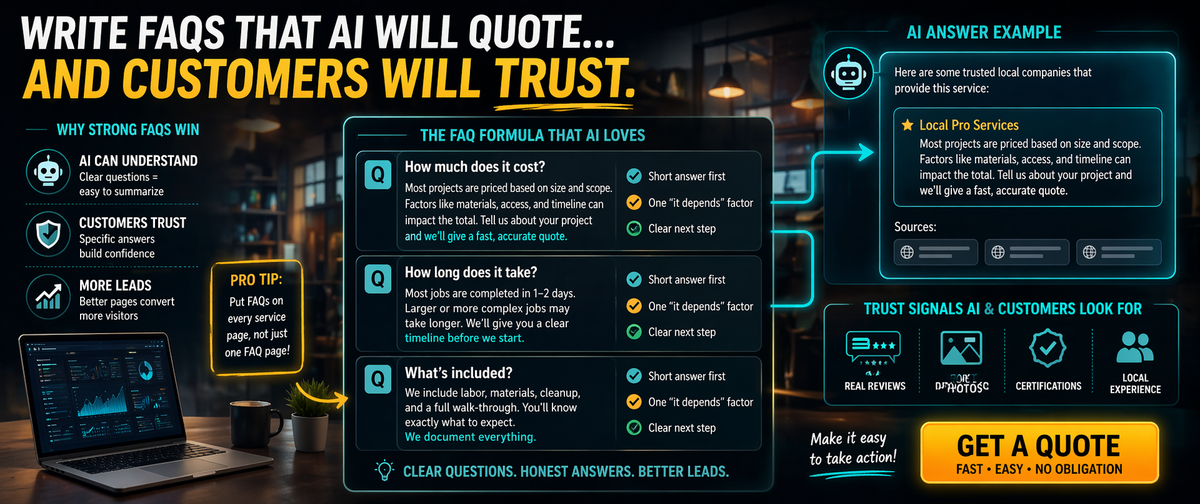
The FAQ formula AI can quote and customers can trust
Use this structure for every FAQ:
1) Short answer first (1–2 sentences)
This is the quote-friendly part.
2) One “it depends” factor (1 sentence)
This is the honesty part.
3) Next step (1 sentence)
This is the conversion part.
Example:
Q: How much does radon testing cost?
Short answer: “Most radon tests are priced based on the type of test and how quickly you need results.”
It depends: “Pricing can change if you need rush scheduling or additional areas tested.”
Next step: “If you tell us your timeline and property type, we can recommend the best option.”
That’s AI-friendly and human-friendly.
The 6 FAQ types AI loves
If you want high-search FAQs, these are your winners.
Cost and pricing factors
Not “what’s the price?” necessarily. AI loves cost factors.
Examples:
- “How much does it cost?”
- “What affects the price?”
- “Do you charge a trip fee?”
- “Is there a minimum?”
Tip: You don’t need exact prices. You need clear pricing logic.
Timeline and scheduling
Examples:
- “How long does this take?”
- “How soon can you schedule?”
- “Do you offer urgent appointments?”
- “What happens after I book?”
This reduces friction and increases conversions.
What’s included
This is huge for trades and service pros.
Examples:
- “What’s included in the service?”
- “What’s not included?”
- “Do you handle cleanup?”
- “Do you provide a written report?”
AI loves clarity. Customers love clarity. Disputes hate clarity.
Service area and availability
Examples:
- “Do you serve Evans/Augusta/Columbia County?”
- “Do you travel to job sites?”
- “Do you work weekends?”
This prevents wasted leads and bad expectations.
Preparation and requirements
Examples:
- “Do I need to be home?”
- “How do I prepare?”
- “What should I send ahead of time?”
- “Can I text photos?”
This is where you win convenience points.
“Is it worth it?” and “Should I be worried?”
These questions drive clicks.
Examples:
- “Is this dangerous?”
- “How do I know if I need this?”
- “What happens if I ignore it?”
- “What are common signs?”
AI answers love this style because it reads like an explainer, not an ad.
Add proof lines to stop sounding generic
AI and customers both trust proof.
Add one proof line to the answer when it fits:
- “We document findings with photos.”
- “We provide a clear next-step report.”
- “We’ve helped homeowners and small businesses across the CSRA.”
Keep it short. Proof should support, not brag.
The phrases to avoid in FAQs
If your answers contain these, they sound useless:
- “It depends” with no explanation
- “Contact us for details”
- “We offer high-quality service”
- “We are the best”
- “We can help with all your needs”
Replace with:
- what factors change the answer
- what a typical process looks like
- what the customer should do next
Should you add FAQ schema?
If you can add it safely, it can help search engines understand your content.
But the bigger win is still the content itself:
- clear question headings
- short answers
- proof
- next steps
If you’re not sure how to add schema, focus on the writing first. Then add schema later once your FAQs are solid.
A practical FAQ template you can copy
Here’s a simple template you can paste into each service page and fill in:
FAQ
Q: How much does [service] cost?
A: [Short answer]. [One factor]. [Next step].
Q: How long does [service] take?
A: [Short answer]. [One factor]. [Next step].
Q: What’s included in [service]?
A: [Short answer]. [One factor]. [Next step].
Q: What’s not included?
A: [Short answer]. [One factor]. [Next step].
Q: Do you serve [areas]?
A: [Short answer]. [One factor]. [Next step].
Q: What do I need to do before you arrive?
A: [Short answer]. [One factor]. [Next step].
Six good FAQs beat twenty vague ones.
Final Thought
If you want AI to quote your site and customers to trust you, your FAQs need to stop being filler.
Use the formula:
- short answer first
- one honest “it depends” factor
- one clear next step
Put FAQs on every money page, not just one FAQ page.
If you want help building FAQ blocks that improve AI visibility and turn into calls, Managed Nerds can structure your service pages, write conversion-friendly FAQs, and connect it all to SEO and tracking so your content produces leads.