AI Search Verification: Why Customers Still Double-Check Before They Call
AI may introduce your business, but proof still closes the gap. Here’s how reviews, Google Business Profile, service pages, and photos help customers verify.

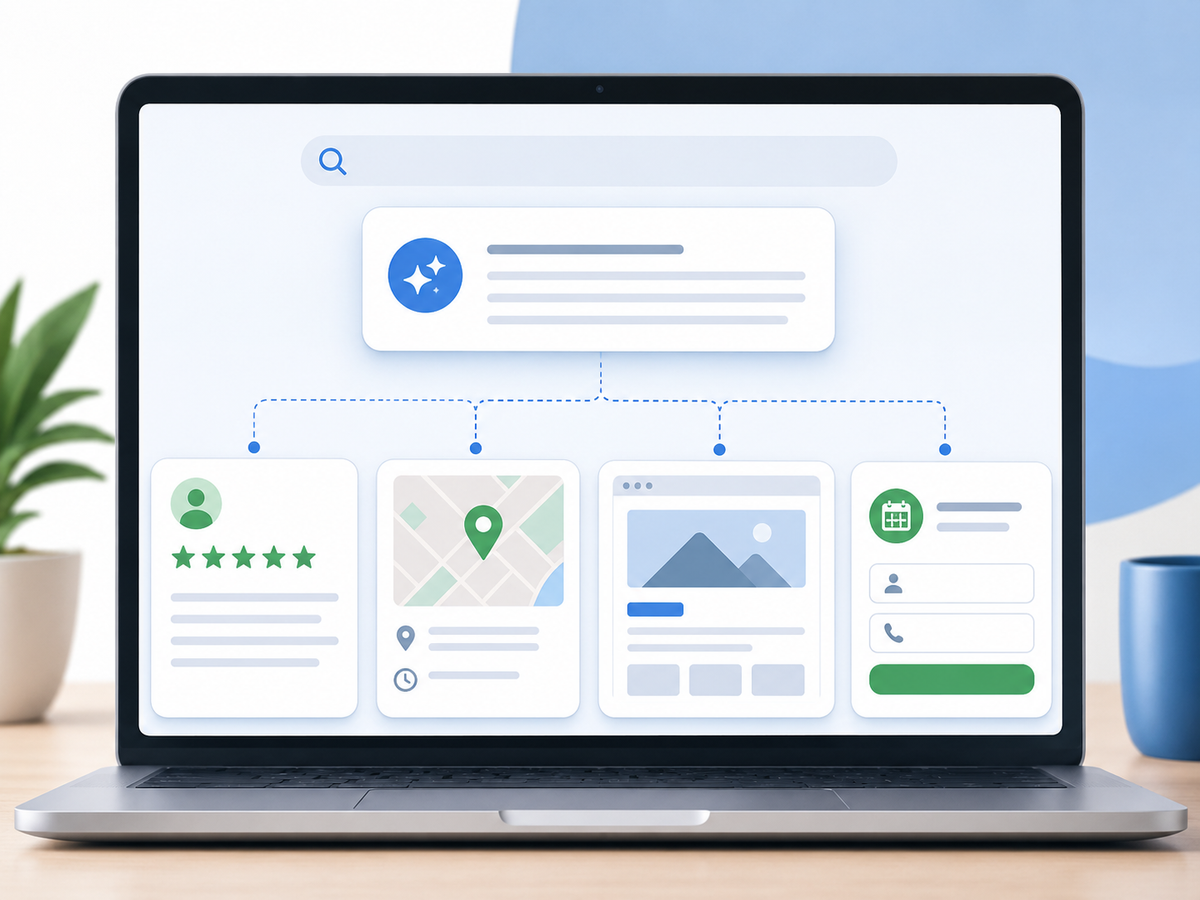
A customer might ask ChatGPT, Gemini, Copilot, or another AI tool:
“Who is the best small business SEO company near Augusta?”
or
“Who can help a small business set up AI tools?”
And AI may give them a recommendation.
That sounds like the finish line.
But it is not.
For most customers, an AI recommendation is only the beginning. They still verify before they act.
A 2026 Yext consumer search report found that 47% of U.S. adults used AI for local search in the past month, but more than 93% of AI users still take at least one verification step before acting. The report also found that 62% search Google immediately after an AI recommendation, 58% visit the business website directly, and 52% click through to sources cited in the AI response.
That is the key lesson:
AI can introduce your business, but your trust signals still close the deal.
AI search does not replace trust
AI recommendations can feel powerful because they shorten the search process.
Instead of scrolling through ten results, the customer gets a short answer.
But people still want to know:
- Is this business real?
- Do they serve my area?
- Do they have good reviews?
- Does the website look trustworthy?
- Are their hours accurate?
- Can I see proof?
- What happens if I contact them?
That is why AI visibility alone is not enough.
If AI recommends you, and then your Google Business Profile is outdated, your reviews are weak, your website is vague, or your photos look abandoned, the customer may move on.
The “verification layer” customers check
Think of the verification layer as everything people check after they discover you.
It includes:
- Google Business Profile
- reviews
- website service pages
- photos
- hours
- service area
- social media
- pricing or process expectations
- contact/booking experience
Yext’s full global report frames the modern customer journey as a multi-surface process where AI, reviews, social, and traditional search all play separate but connected roles. It also notes that AI visibility without a strong verification layer can produce recommendations that do not convert.
That is exactly what small businesses need to understand.
Being found is step one.
Being trusted is step two.
Verification signal #1: Google Business Profile
For local businesses, Google Business Profile is often the first place people check.
They want to see:
- accurate business name
- correct hours
- service area
- phone number
- reviews
- photos
- services
- recent activity
If your GBP looks outdated, it creates doubt.
Even if AI recommends you, a weak profile can stop the lead.
Quick fixes:
- update hours and holiday hours
- clean up services
- add fresh photos
- request steady reviews
- respond to reviews
- make sure your service area is accurate
Verification signal #2: Reviews
Reviews answer the question:
“Can I trust them?”
Customers are not just looking at the star rating. They are reading the words.
They want to know:
- what service you helped with
- whether you responded quickly
- whether you explained things clearly
- whether the experience felt professional
- whether others like them had a good outcome
This is why review quality matters.
A vague review like “Great company” is nice.
A specific review like “Managed Nerds helped us clean up our Google Business Profile and understand what was holding back our local SEO” is far more useful.
Verification signal #3: Website service pages
Your website is where customers verify the details.
If your service page is vague, AI may introduce the lead, but your website may lose them.
Strong service pages should clearly show:
- what you do
- who you help
- where you serve
- what is included
- what happens next
- proof or examples
- simple call-to-action
This is especially important for AI search because customers may arrive with a specific question already in mind.
If your page does not answer that question quickly, trust drops.
Verification signal #4: Photos
Photos make your business feel real.
For service businesses, photos can show:
- your team
- your process
- completed work
- tools or equipment
- office or work environment
- real examples
- before-and-after proof
Photos help customers confirm that your business is active and legitimate.
If the last photo on your profile is three years old, it sends the wrong signal.
Verification signal #5: Social media presence
Social media is not always the main sales channel, but it can influence trust.
A customer may check your Facebook, Instagram, LinkedIn, or YouTube to see:
- Are you active?
- Do you explain things clearly?
- Do you seem real?
- Do you have recent posts?
- Do you show proof?
- Do you answer questions?
Yext’s report also found that social content quality, follower count, and brand familiarity from social become more influential among the highest-trust AI users.
That does not mean every small business needs to chase followers.
It means your social presence should support your credibility.
Verification signal #6: Consistent information
Inconsistent information kills confidence.
If AI says one thing, Google says another, and your website says something else, customers get nervous.
Common problems:
- different phone numbers
- wrong hours
- outdated services
- old address
- unclear service area
- old pricing language
- old staff or brand information
AI search makes consistency more important because customers may jump across multiple surfaces quickly.
They might go from AI answer to Google search to website to reviews in under two minutes.
Everything needs to match.
The trust stack: what to update first
If you want to strengthen your verification layer, start with this order:
1) Google Business Profile
Update the basics:
- hours
- services
- categories
- phone
- photos
- service area
2) Website service pages
Make your core services clear:
- what you do
- who you help
- where you serve
- what happens next
3) Reviews
Ask consistently and ethically.
Encourage customers to mention the specific service you helped with.
4) Photos and proof
Add recent proof:
- project photos
- process photos
- screenshots
- examples
- testimonials
5) Social and content
Post helpful, recent content that reinforces your expertise.
What small businesses should not do
Do not try to “hack” AI search while your basic trust signals are weak.
Avoid:
- fake reviews
- keyword-stuffed content
- outdated service pages
- overpromising in AI-focused content
- ignoring Google Business Profile
- letting directories show wrong information
- posting generic AI-written blogs with no real value
AI search may change the first step of discovery.
It does not remove the need for credibility.
A simple AI verification checklist
Ask yourself:
- If AI recommends us, will Google confirm we are active?
- Do our reviews mention our real services?
- Does our website clearly explain what we do?
- Are our hours and service area consistent?
- Do our photos look current?
- Can a customer quickly understand the next step?
- Do our social posts support trust?
- Are old listings or directories saying the wrong thing?
If any answer is no, that is where to start.
The bottom line
AI search may introduce your business to more people.
But customers still verify before they call.
They check Google. They check your website. They check reviews. They check photos. They look for consistency.
So the winning strategy is not just “show up in AI.”
It is:
Show up clearly, then back it up everywhere customers verify.
Need help strengthening the trust signals customers check after AI search recommends you? Managed Nerds offers practical small business SEO and marketing support to clean up Google Business Profile, improve service pages, strengthen review strategy, and build a clearer online presence that turns visibility into real leads.
Thank you for reading. If you’d like more small business SEO tips, subscribe for updates.