Could Your Employees Recognize Your Voice… If It Was Fake?
AI voice cloning can imitate trusted voices with alarming accuracy. Learn how small businesses can recognize these scams and protect employees through awareness and verification.

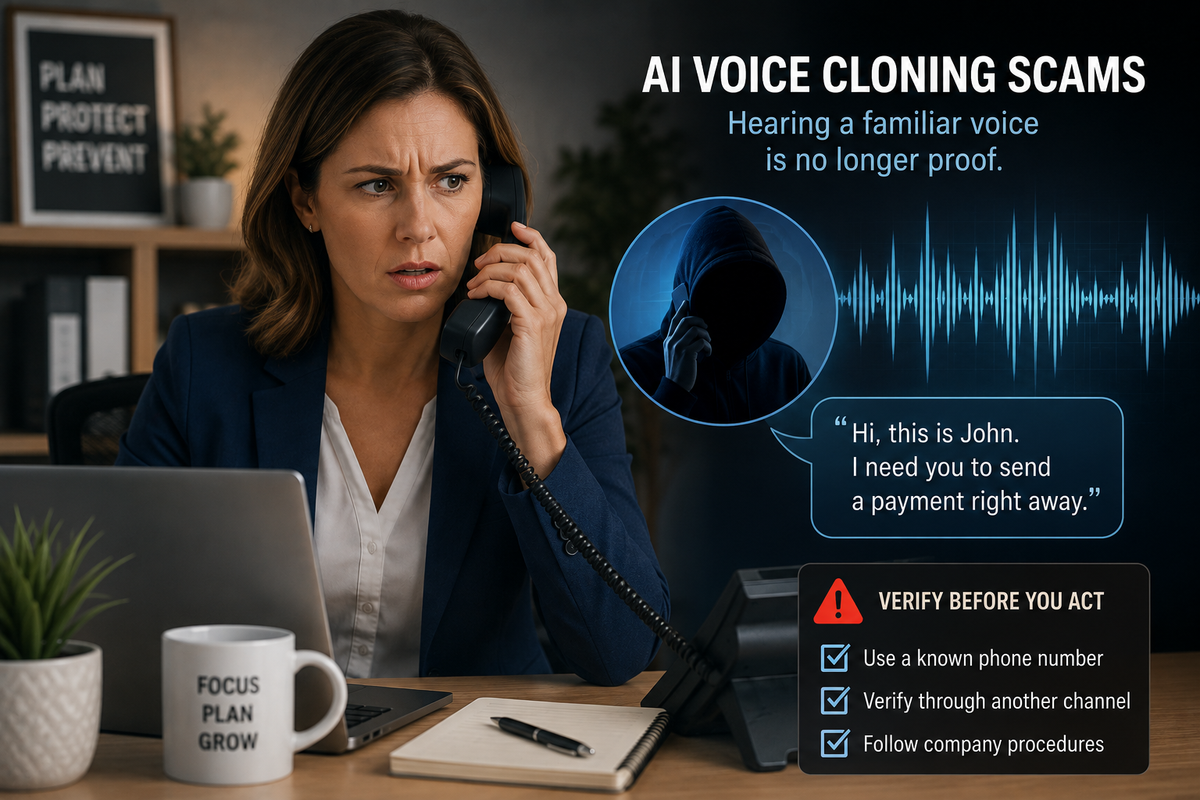
Not long ago, hearing a familiar voice on the phone was enough to build trust.
Today, that may no longer be true.
Artificial intelligence has made voice cloning more realistic than ever, allowing scammers to imitate the voices of family members, executives, coworkers, and even business owners using only a short audio sample. Recent reports have highlighted real victims who believed they were speaking to a loved one in distress, only to discover later that the voice was generated by AI.
For small businesses, this isn't just a personal concern—it's becoming a business security issue.
What Is an AI Voice Clone Scam?
Voice cloning uses artificial intelligence to recreate a person's voice after analyzing a relatively small amount of audio.
Scammers can gather those audio samples from places like:
- Social media videos
- Podcasts
- Company websites
- YouTube videos
- Voicemail greetings
- Public presentations
Once they have enough audio, they can generate speech that sounds remarkably similar to the original person.
Why Small Businesses Should Pay Attention
Imagine receiving a phone call that sounds exactly like your business owner.
They urgently ask you to:
- Wire money to a vendor
- Purchase gift cards for a client
- Share customer information
- Reset an account password
- Send payroll records immediately
If the voice sounds genuine, many employees may comply before stopping to verify the request.
That's exactly what makes voice-cloning scams so dangerous.
The technology isn't attacking your computers.
It's attacking your trust.
This Isn't Just a Family Scam Anymore
Many of the stories making headlines involve parents receiving calls from someone who sounds exactly like their child asking for emergency financial help. Victims have lost thousands of dollars because they believed the voice was authentic.
The same tactics can easily be adapted for businesses.
Cybercriminals could impersonate:
- Business owners
- Office managers
- CFOs
- Vendors
- Attorneys
- Customers
- IT providers
As AI improves, these scams will likely become even more convincing.
Why Hearing a Familiar Voice Is No Longer Proof
For years, people have trusted voices because they're difficult to fake.
That's changing.
Experts now warn that hearing someone you know should no longer be considered proof of identity on its own. Instead, important requests should always be verified through another trusted method before taking action.
For businesses, that could mean:
- Calling the person back using a known phone number.
- Verifying requests through Microsoft Teams, Slack, or email.
- Confirming financial requests with a second employee.
- Following documented approval procedures.
A two-minute verification could prevent thousands of dollars in losses.
Employee Training Is Your Best Defense
Technology can help detect many threats.
But voice-cloning scams target people.
That's why employee training is becoming more important than ever.
Employees should know:
- Never act on urgent financial requests without verification.
- Be cautious of unexpected phone calls asking for sensitive information.
- Understand that caller ID and a familiar voice can both be spoofed.
- Follow company approval processes—even during emergencies.
- Report suspicious calls immediately.
Good security habits are often more effective than expensive technology.
Create a Verification Process Before You Need One
Every small business should have a simple procedure for verifying high-risk requests.
For example:
- Require a second approval for wire transfers.
- Verify banking changes through a known contact.
- Use a predetermined verification phrase for sensitive requests.
- Never rely solely on a phone call for financial decisions.
Having these policies in place before an incident occurs can significantly reduce your risk.
How Managed Nerds Helps Businesses Prepare
Emerging technologies like AI bring incredible opportunities, but they also create new risks that businesses need to understand.
Managed Nerds helps small businesses stay ahead by providing:
- Cybersecurity awareness training
- Social engineering education
- Managed IT services
- Identity and access security guidance
- Email and account security
- Technology consulting
- AI awareness and business AI training
- Ongoing security monitoring and best-practice guidance
The goal isn't to make businesses fear AI.
It's to help them use modern technology safely while preparing employees for the threats that come with it.
Final Thought
AI voice cloning is a reminder that cybersecurity is no longer just about protecting computers.
It's about protecting trust.
As scammers become better at sounding like people we know, businesses need to shift from trusting voices to trusting processes.
Because in today's world, the question isn't:
"Could someone fake my voice?"
It's:
"Would my employees know how to respond if they did?"
Need Help Preparing Your Business for Modern AI Threats?
As AI continues to change the way businesses operate, employee awareness is becoming one of the strongest cybersecurity investments you can make.
Managed Nerds helps small businesses strengthen their security through managed IT services, cybersecurity awareness training, AI consulting, and practical technology guidance—so your team is prepared for today's threats and tomorrow's innovations.
Want More Simple Tech Tips Like This?
Subscribe for practical technology and cybersecurity insights designed specifically for small business owners who want to stay informed, protected, and confident in an increasingly AI-driven world.