How Do I Use AI to Train New Employees Faster (Without Micromanaging)?
If training new hires feels like repeating yourself forever, you don’t need more time, you need a system. Here’s how AI turns SOPs into training that actually sticks.

Training is one of the most expensive hidden costs in a small business.
Not because you don’t want to train.
Because training usually looks like this:
- You explain it once
- They nod
- They do it slightly wrong
- You correct it
- They do it differently wrong
- You correct it again
- You start thinking, “It’s faster if I just do it myself”
That’s how owners become trapped in the work.
AI can help, but not by replacing your judgment. The real win is this:
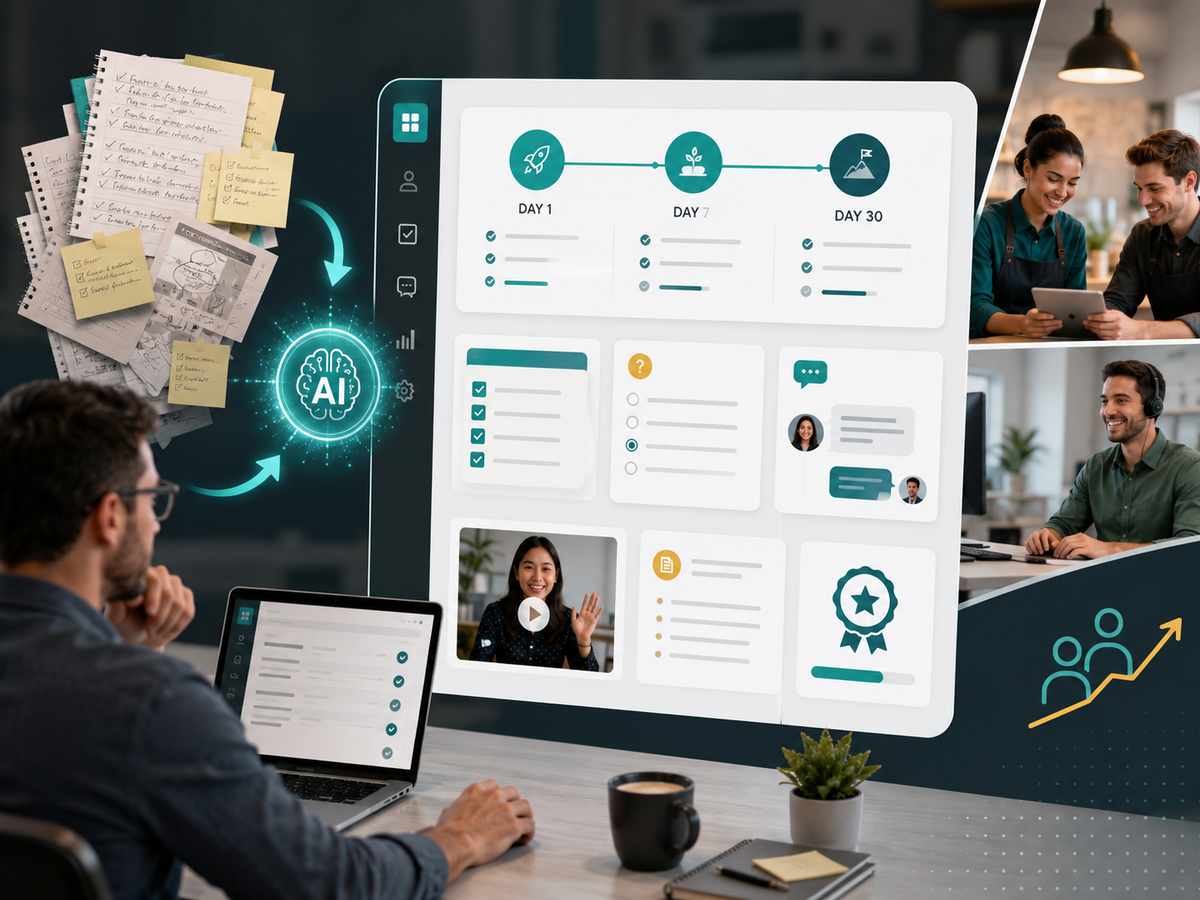
AI turns your SOPs into training assets that repeat themselves, consistently, without you.
Let’s build a system that makes new hires better faster, without turning you into a micromanager.
New hires aren’t “bad.” They’re guessing.
And guessing is what happens when training lives in your head.
If your business runs on “watch me and figure it out,” you will always be retraining.
AI can turn that tribal knowledge into:
- onboarding checklists
- mini quizzes
- roleplay scripts
- “what to do when…” decision trees
- weekly training plans
That’s how training becomes a system.
The goal of training: predictable performance, not perfect understanding
Small business training doesn’t need to be fancy. It needs to produce:
- fewer mistakes
- consistent customer experience
- fewer “what do I do?” questions
- faster time-to-competent work
AI is great at creating repetition and structure. That’s exactly what training needs.
Start here: one SOP becomes five training tools
If you already have an SOP (or you can create one like we did in Blog 29), you can turn it into these five assets.
1) A Day 1 checklist
This is “what they must know before they touch live work.”
Examples:
- how to answer the phone
- how to log a lead
- how to confirm an appointment
- where the tools are
- what not to promise
- where the SOP binder lives
AI prompt: Day 1 checklist
“Turn this SOP into a Day 1 training checklist.
Goal: prevent mistakes on the first day.
Format: checklist with 10–15 items max.”
2) A Day 7 checklist
This is “what they should be doing with less supervision.”
Examples:
- handling scheduling correctly
- collecting required info for quotes
- using the proper scripts
- documenting work consistently
AI prompt: Day 7 checklist
“Turn this SOP into a Day 7 checklist.
Assume the employee has basic familiarity.
Include common errors and how to avoid them.”
3) A Day 30 scorecard
This is how you stop training from being emotional.
A Day 30 scorecard measures:
- accuracy
- speed
- consistency
- customer communication
- documentation habits
AI prompt: Day 30 scorecard
“Create a Day 30 scorecard for this SOP.
Include 8–12 criteria with simple pass/fail or 1–5 ratings.
Add notes for what ‘good’ looks like.”
Now you can coach based on a standard, not vibes.
4) A 5-question quiz (that checks understanding fast)
Quizzes aren’t for school. They’re for catching gaps before mistakes hit customers.
Good quiz questions are scenario-based.
Example:
“A customer reschedules. What must you confirm in writing?”
AI prompt: SOP quiz
“Create a 5-question quiz based on this SOP.
Use scenarios, not definitions.
Include the correct answer and a 1-sentence explanation.”
Quizzes are perfect for:
- office staff
- admins
- sales assistants
- dispatch/scheduling roles
5) Roleplay scripts (that build confidence)
Roleplay is a cheat code for training, especially for:
- sales calls
- complaint handling
- scheduling
- collections
- policy explanations
AI prompt: Roleplay training
“Create 3 short roleplay scenarios based on this SOP.
For each scenario:
- customer message
- ideal employee response
- what not to say
Keep responses in a calm, confident tone.”
Roleplay prevents the “freeze” moment when a real customer pushes back.
The “micro-training” approach that works in tiny teams
Most owners don’t have time for hour-long training blocks.
So use micro-training:
- 10 minutes a day
- one SOP topic at a time
- one quick quiz
- one roleplay
- one checklist
This is how you build skill without killing your day.
A simple weekly cadence
- Monday: review one SOP checklist
- Tuesday: do one 5-question quiz
- Wednesday: roleplay one scenario
- Thursday: shadow + feedback on real tasks
- Friday: 10-minute recap: what went well, what to improve
AI can generate the quiz and roleplay each week from the SOP, so you’re not writing training materials from scratch.
Train for decisions, not just steps
Most mistakes happen at decision points, not basic steps.
Examples:
- “Do we book without confirmation?”
- “When do we collect a deposit?”
- “What do we do when a customer is angry?”
- “When do we escalate to the owner?”
So create decision trees.
AI prompt: Decision tree
“Create a decision tree for this SOP.
Use If/Then rules for the 5 most common decision points.
Format: bullet list.”
Decision trees reduce “guessing,” which is what owners hate most.
The “buddy system” without the chaos
If you have more than one employee, use a buddy approach:
- new hire shadows
- buddy checks work
- owner only handles escalations
AI can give the buddy a checklist for what to watch for.
AI prompt: Buddy checklist
“Create a buddy checklist for reviewing a new hire using this SOP.
Include 10 things to check and common mistakes.”
Now coaching is consistent.
Don’t let AI become the trainer that makes stuff up
Training content must be accurate.
Use this rule:
AI drafts training materials, but your SOP is the authority.
When prompting, always add:
“Do not invent facts. Use only the SOP content. If unclear, ask questions.”
This prevents hallucinated “rules” that don’t match your business.
What this does for your business (fast)
When you train this way, you get:
- fewer customer-facing mistakes
- less rework
- more consistent service
- faster new hire confidence
- less owner interruption
And the best part:
You stop repeating yourself.
Final Thought
AI won’t replace your leadership.
But it can absolutely replace the endless repeating.
If you already have SOPs, AI can turn them into:
- Day 1, Day 7, Day 30 training plans
- quizzes
- roleplay scripts
- decision trees
- scorecards
That’s how you train faster, without micromanaging.
If you want help building SOPs and transforming them into onboarding systems, quizzes, and roleplay training your team can actually use, Managed Nerds can set up the full training workflow and prompt pack for your business.