Google Is Removing Language Targeting From Your Campaigns
Google is retiring campaign-level language targeting in Search and Performance Max. Learn what replaces it and whether your account needs any changes.

There's a setting in your Google Ads campaigns that most people set once, years ago, and never looked at again. It's about to stop existing.
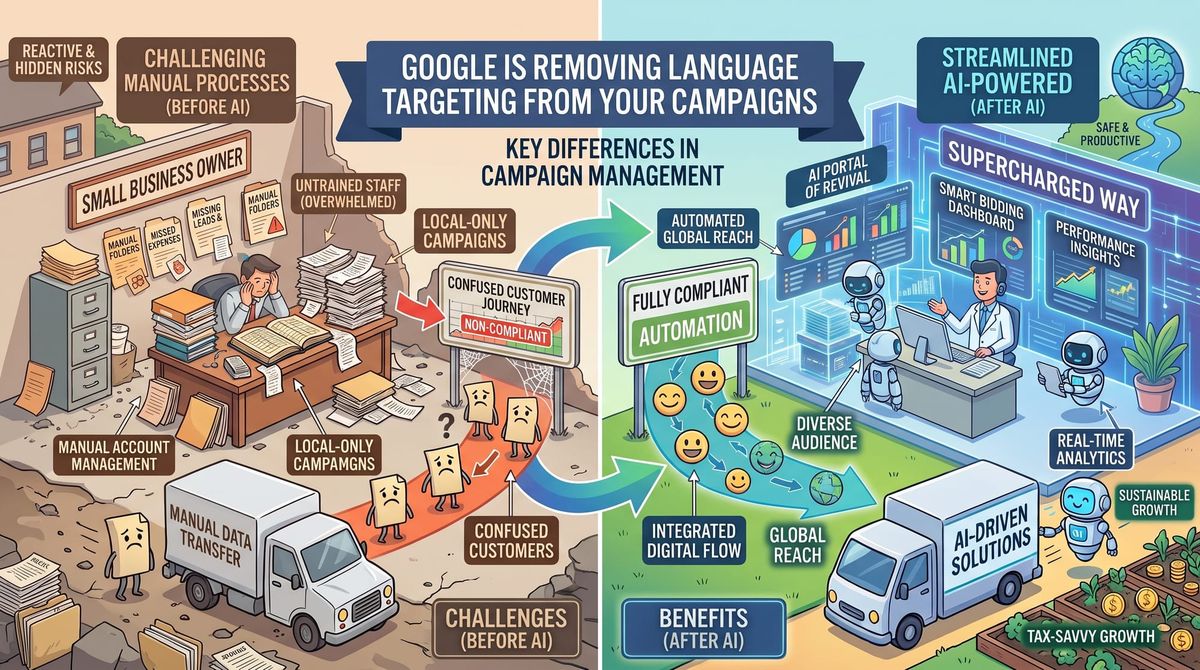
Campaign-level language targeting is being removed from Search and Performance Max campaigns. Instead of you telling Google which languages to target, Google will give priority to ads and landing pages written in the language that matches what the person searched.
Search in German, and Google favors German ads pointing at German pages. Search in English, and it favors English.
Who this affects, honestly
If you run English-only campaigns pointing at an English website — which describes most small businesses — this changes essentially nothing for you. Google has said there's no change for advertisers running single-language campaigns. Your reporting stays the same. Your targeting behaves the same.
So this post is short on purpose, and the honest headline is: check the setting, then get on with your day.
Where it matters is if you're in one of these situations:
- You serve customers in more than one language.
- You have a website with pages in a second language, or a translated version of your site.
- You've run ads in a second language, or thought about it.
- Someone built your campaigns for a market you no longer serve, and the language setting is a leftover.
For those accounts, the control you had is going away and being replaced with something you influence differently.
The new lever is your content, not your settings
This is the actual shift worth understanding. You no longer tell Google what language to target. Google reads the language of your ad creative and your landing page and matches accordingly.
Google's guidance is that advertisers should make sure their ad copy and landing pages are clearly structured in the intended language for their intended audience. That's the whole job now.
Which means the failure mode is different than it used to be. Previously, if your language setting was wrong, you'd miss people. Now, if your page is ambiguous — an English page with a Spanish headline, or a translated page that never quite got finished — you'll get matched in ways you didn't intend, and no setting will fix it.
What to actually do
If you're single-language: nothing. You might remove the language criteria from your campaigns for tidiness, since it no longer applies, but it isn't urgent.
If you serve multiple languages: this is the week to look at your site. Each language needs its own clean landing page, fully translated — not an English page with a translated headline bolted on, and not a page relying on a browser translate plugin. If you want ads to serve in a language, you need a real destination in that language.
If you run separate campaigns per language: they'll keep running, but the separation is now driven by your creative and pages rather than the setting. Make sure the ad copy in each campaign is genuinely in the language it's meant for.
If you use the Google Ads API or scripts: Google has recommended no longer including language criteria in new and updated Search campaigns sent through the API. Anything automated that sets language should be updated.
While you're in there
This is a decent excuse to look at the other settings nobody revisits. Location targeting is the big one — specifically whether you're targeting people in your service area or people interested in it, which is a distinction that quietly wastes money for local businesses.
Ad schedule, device bid adjustments, and audience exclusions are all worth the same five-minute look. Settings that were right when the account was built are often wrong three years later, and nobody gets an alert about it.
Bottom line
For most small advertisers this is a non-event, and you should treat it as one. But it's part of a consistent direction: Google keeps replacing settings you control with signals it reads from your content.
The practical takeaway is that your landing pages are doing more work in your ad account every year. Clear, complete, genuinely-in-the-right-language pages aren't just good for conversion now — they're how you steer the targeting.
Want someone to review the settings nobody's opened in three years, and make sure your pages are pulling their weight? Our small business SEO and marketing services cover both the account and the site it points to. Reach out and we'll take a look.