
The Welcome Email Sequence: What to Send After Someone Downloads Your Lead Magnet
A lead magnet is only step one. Here’s what to send after someone downloads your checklist, guide, or template so they stay engaged and trust you.

Getting someone to download your checklist, guide, template, or scorecard is a win.
But it is not the finish line.
It is the beginning of the relationship.
A lot of small businesses create a lead magnet, collect the email address, send the download, and then stop.
That is a mistake.
If someone downloaded your resource, they are interested in the topic. They may not be ready to buy today, but they are paying attention.
A welcome email sequence helps you stay useful, build trust, and guide them toward the next step without sounding pushy.
Why one delivery email is not enough
The first email usually has one job:
“Here is the thing you requested.”
That is helpful, but it does not build much of a relationship by itself.
After that first email, your lead may still be wondering:
- Can this business actually help me?
- What should I do with this checklist?
- What problem should I fix first?
- Is this worth a conversation?
- Will they pressure me if I reach out?
A short welcome sequence answers those questions slowly and naturally.
The simple 4-email welcome sequence
You do not need 20 emails.
You do not need complicated automation.
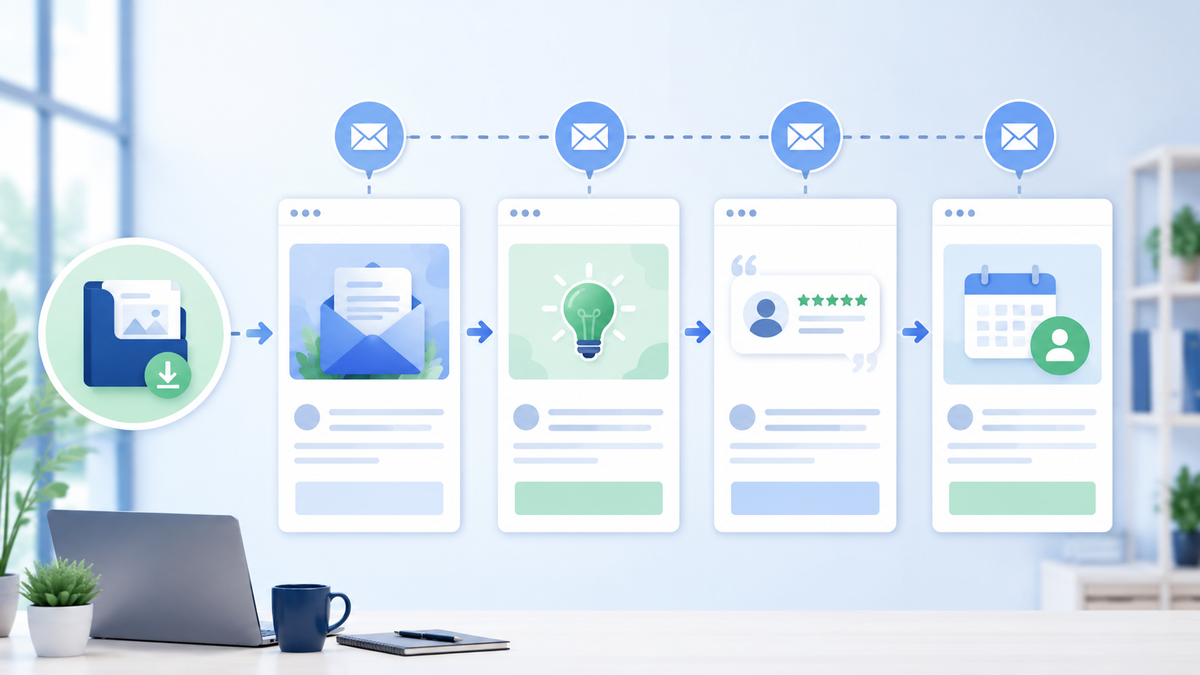
Start with four emails:
- Deliver the resource
- Give one extra helpful tip
- Show proof
- Offer a soft next step
That is enough to turn a cold download into a warmer lead.
Email #1: Deliver the resource
Send this immediately after they sign up.
Do not make people wait.
The email should be short and clear.
Goal
Deliver what they requested and set expectations.
What to include
- Link to the checklist, guide, or template
- One sentence explaining how to use it
- A short “what happens next” line
- Optional link to a related blog
Example
Subject: Here’s your checklist
“Thanks for downloading the Small Business SEO Readiness Checklist. You can use it to quickly spot the biggest gaps in your website, Google Business Profile, and lead tracking.
Start with the sections you can fix this week. We’ll send one extra tip tomorrow to help you get more value from it.”
Simple. Helpful. No hard sell.
Email #2: Send one extra tip
Send this one day later.
This email should help them use the resource better.
Goal
Prove that you are helpful, not just collecting emails.
What to include
- One practical tip
- One short explanation
- One related link if useful
Example
Subject: Start with the easiest fix first
“Quick tip: when you review your checklist, don’t start with the hardest item. Start with the fix that removes the biggest leak.
For many small businesses, that is usually one of these:
- outdated Google Business Profile info
- unclear service area
- slow landing page
- contact form with too many fields
- no call tracking
Fixing one of those can make your existing traffic work harder before you spend more money.”
This email builds trust because it gives them something useful immediately.
Email #3: Show proof or a real example
Send this two to three days after Email #2.
This is where you show that the advice is not just theory.
Goal
Build confidence and reduce hesitation.
What to include
- A short customer-style example
- A “before and after” style explanation
- A result, if you can share it honestly
- A testimonial, if appropriate
Example
Subject: A small fix can change the whole lead flow
“One common issue we see is a business getting traffic but losing leads at the contact step.
The site might have a long form, vague CTA, or no clear response expectation.
A simple fix could be:
- cut the form down to 3–5 fields
- add a clear service area
- add one proof block near the CTA
- create a thank-you page that explains what happens next
That kind of cleanup makes your SEO and ad traffic more useful because more visitors know what to do.”
You are not bragging. You are showing what better looks like.
Email #4: Offer a soft next step
Send this two to four days after Email #3.
This is your invitation.
Not a pushy sales pitch.
A clear, low-pressure next step.
Goal
Invite the reader to start a conversation.
What to include
- Recap the problem
- Mention the outcome
- Offer help
- Keep it low pressure
Example
Subject: Want a second set of eyes?
“If you used the checklist and found a few gaps, that is normal.
Most small business websites have at least one of these issues:
- unclear service pages
- weak Google Business Profile signals
- no tracking
- slow landing pages
- forms that lose leads
If you want a second set of eyes, Managed Nerds can help review where your SEO and lead flow may be leaking. You can reply to this email or request a quick conversation.”
That is enough.
What not to do in a welcome sequence
Avoid these common mistakes.
Do not hard sell immediately
If the first email after a download is basically “Buy now,” you will lose trust.
They asked for a resource. Give them the resource.
Do not send long corporate emails
Keep the emails short.
One idea per email.
Most people are reading on a phone.
Do not disappear for months
If someone downloads your guide and then hears nothing for three months, they will forget who you are.
A short welcome sequence keeps the relationship warm.
Do not send generic filler
Every email should have a reason to exist.
If it does not help, prove, explain, or guide, cut it.
How to connect this back to tracking
Use UTM links in your emails when you link back to your website.
For example:
- link to a related blog
- link to a booking page
- link to a service page
- link to another downloadable resource
This helps you see which emails create real engagement.
Track:
- open rate
- click rate
- replies
- booked calls
- unsubscribes
- which resource produced the best leads
Do not obsess over every number. Look for useful patterns.
How this supports SEO
A welcome sequence supports SEO indirectly because it helps you get more value from the traffic you already earned.
SEO brings people in.
The lead magnet captures them.
The welcome sequence builds trust.
The next step turns that interest into a real conversation.
Without the sequence, many of those visitors disappear.
A simple timeline
Here is the full sequence:
Email 1: Immediately
Deliver the resource.
Email 2: Day 1
Give one extra helpful tip.
Email 3: Day 3
Show proof or an example.
Email 4: Day 5–7
Offer a soft next step.
That is manageable.
That is enough to start.
The bottom line
A lead magnet gets someone’s attention.
A welcome sequence keeps it.
Do not stop at the download.
Send four simple emails:
- deliver the resource
- give one helpful tip
- show proof
- offer a soft next step
That is how you turn a website visitor into a warmer lead without being pushy.
Need help building a simple email follow-up system that supports small business SEO and lead generation? Managed Nerds offers practical SEO and marketing support to help you create lead magnets, improve landing pages, set up tracking, and build follow-up sequences that turn website traffic into real conversations.
Thank you for reading. If you’d like more small business SEO tips, subscribe for updates.