24 Billion Passwords Exposed? Here's What Small Businesses Need to Do Right Now
Researchers uncovered a massive collection of 24 billion stolen credentials. Here's what small businesses need to know about password security and account protection.

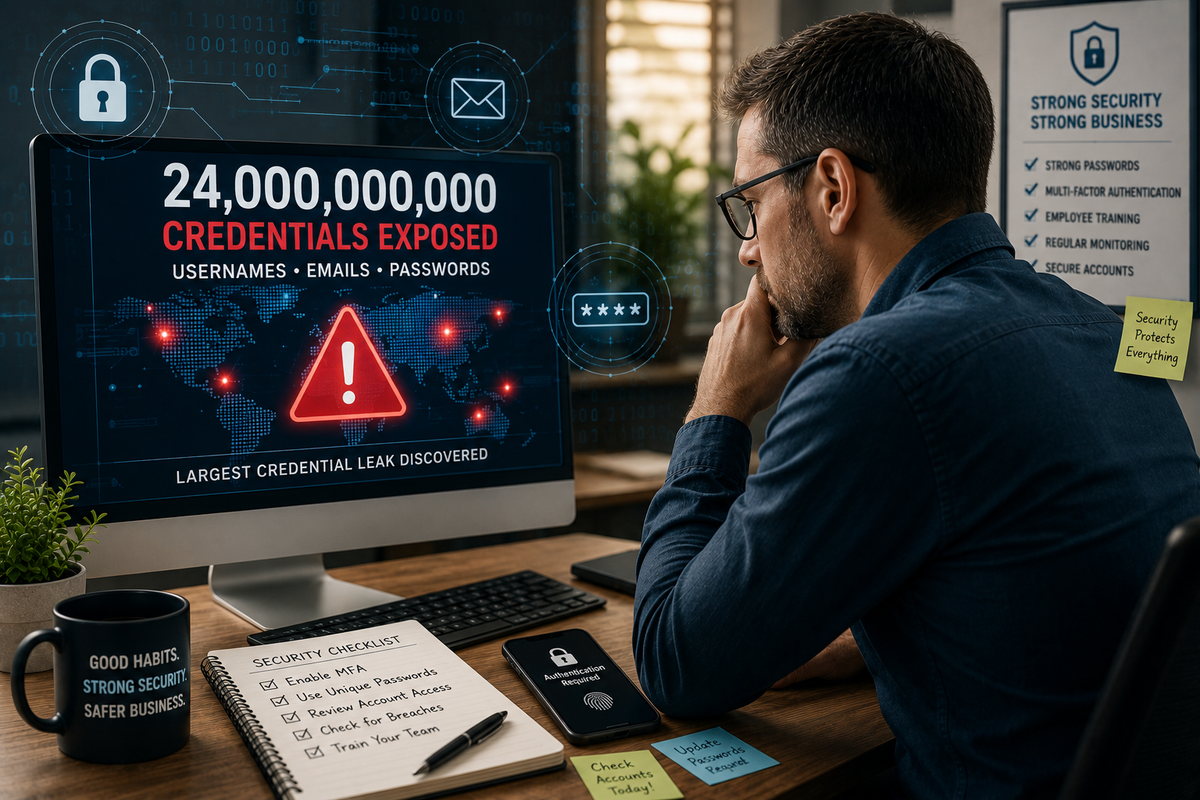
When you hear a number like 24 billion, it almost sounds impossible.
But that's exactly why a recent cybersecurity report is getting so much attention.
Researchers recently analyzed one of the largest collections of stolen credentials ever discovered, containing an estimated 24 billion usernames, passwords, and authentication records gathered from numerous breaches and information-stealing malware campaigns.
For small business owners, the headline isn't just shocking.
It's a reminder that stolen passwords remain one of the biggest cybersecurity threats facing businesses today.
What Happened?
According to reports, researchers uncovered an enormous collection of credentials that had been harvested through various cybercriminal operations.
Importantly, this wasn't necessarily one single breach.
Instead, it appears to be a massive aggregation of data collected from:
- Previous breaches
- Malware infections
- Credential theft campaigns
- Phishing attacks
- Compromised websites and applications
The result is a database containing billions of credentials that criminals may use to target accounts across the internet.
Why This Matters for Small Businesses
Many business owners assume attackers are trying to break into systems through sophisticated hacking.
Often, they don't need to.
If a password is already stolen, attackers may simply try logging in.
Businesses today rely on accounts for:
- Banking
- Accounting platforms
- Social media
- Customer relationship management (CRM) systems
- Cloud storage
- Vendor portals
A single compromised password can sometimes provide access to much more than people realize.
The Bigger Problem: Password Reuse
One of the most common cybersecurity mistakes is password reuse.
For example:
An employee uses the same password for:
- A shopping website
- A social media account
- Their work email
If one of those sites experiences a breach, attackers often test the same credentials elsewhere.
This technique, known as credential stuffing, remains one of the most successful attack methods used today.
Why Passwords Alone Aren't Enough Anymore
The 24-billion-record discovery highlights something cybersecurity professionals have been saying for years:
Passwords by themselves are no longer sufficient protection.
Even strong passwords can become exposed through:
- Data breaches
- Malware infections
- Phishing attacks
- Compromised devices
- Third-party incidents
That's why modern security increasingly relies on multiple layers of protection.
What Could Happen to a Small Business?
If attackers gain access to business accounts, the consequences can be significant.
Potential impacts include:
Email Account Compromise
Attackers can impersonate employees, vendors, or business owners.
Financial Fraud
Fake invoices and payment redirection scams often begin with compromised accounts.
Customer Data Exposure
Sensitive customer information may become accessible.
Business Disruption
Locked accounts and security investigations can interrupt normal operations.
Reputation Damage
Customers expect businesses to protect their information.
For many small businesses, recovery can be far more expensive than prevention.
What Businesses Should Be Doing Right Now
The good news is that there are practical steps businesses can take immediately.
Enable Multi-Factor Authentication (MFA)
Even if a password is stolen, MFA can significantly reduce the likelihood of account compromise.
Use Unique Passwords
Every important account should have its own password.
Consider a Password Manager
Password managers help employees create and store strong credentials safely.
Monitor for Breach Exposure
Businesses should periodically check whether company accounts have appeared in known breaches.
Train Employees
Many credential theft incidents begin with phishing emails or malicious websites.
Employee awareness remains one of the strongest defenses available.
Why Employee Training Still Matters
Technology can help.
But people remain a critical part of cybersecurity.
Employees should understand:
- How phishing attacks work
- How credentials are stolen
- Why password reuse is dangerous
- How to recognize suspicious login requests
- The importance of MFA
A well-trained employee can often stop an attack before technology even gets involved.
How Managed Nerds Helps Businesses Reduce Credential Risks
At Managed Nerds, cybersecurity isn't just about installing software.
It's about helping businesses build stronger security habits and defenses.
Managed Nerds helps businesses by:
- Implementing multi-factor authentication
- Improving password security practices
- Providing cybersecurity awareness training
- Monitoring systems for suspicious activity
- Securing user accounts and devices
- Supporting incident response and recovery
- Developing layered cybersecurity strategies
The goal is to reduce risk before stolen credentials become a business problem.
Final Thought
The discovery of 24 billion stolen credentials may sound overwhelming.
But the lesson is actually simple.
Attackers continue targeting passwords because passwords continue working.
The businesses that protect themselves best aren't necessarily the ones with the biggest budgets.
They're the ones that take basic security practices seriously.
Strong passwords.
Multi-factor authentication.
Employee training.
Layered security.
Those fundamentals still matter.
Need Help Strengthening Your Business Security?
If you're unsure whether your accounts, devices, or employees are adequately protected against modern credential theft threats, Managed Nerds can help you build a stronger security foundation.
Want More Simple Tech Tips Like This?
Subscribe for practical cybersecurity and technology insights designed specifically for small business owners who want to stay informed, protected, and prepared.