How Can Solo Business Owners Use AI When They Don’t Have an Assistant?
Running a one-person business means wearing every hat. Here’s how solopreneurs can use AI to handle admin work, follow-ups, planning, and content without hiring an assistant.

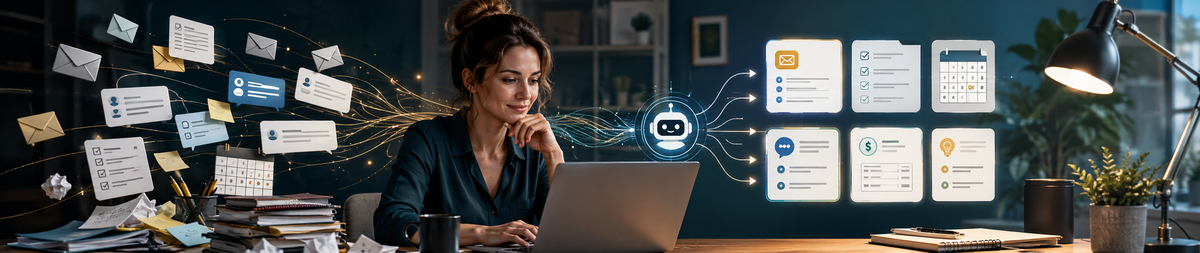
Running a one-person business sounds simple until you actually do it.
You are the owner.
The salesperson.
The customer service department.
The scheduler.
The marketer.
The bookkeeper, at least until tax time gets scary.
The follow-up person.
The content creator.
The complaint handler.
The admin assistant.
And somehow, you are also supposed to do the actual work customers pay you for.
That is the part people forget.
A solo business owner is not just trying to grow. They are trying to keep all the moving pieces from falling on the floor.
Here is the tabloid truth:
No assistant? AI can help you stop doing everything alone.
Not because AI can replace your judgment.
Not because AI can magically run your business.
Not because you should hand over your client relationships to a robot.
AI can help with the daily admin work that eats your time, drains your focus, and keeps you stuck in reactive mode.
Why solo business owners need a different AI strategy
A larger company may use AI for teams, departments, reporting, and complex workflows.
A solo business owner usually needs something much simpler:
- What do I need to answer today?
- Who did I forget to follow up with?
- What should I post this week?
- What do I need to send before this appointment?
- What tasks actually matter today?
- How do I sound professional without spending 30 minutes writing one email?
- How do I stop keeping the whole business in my head?
That is where AI can help.
For a solo owner, AI works best as a first-draft assistant, organizer, and thinking partner.
It helps you start faster.
You still review, edit, approve, and decide.
Use Case 1: Turn messy thoughts into a daily plan
Solo owners often start the day with too many tasks and no clear order.
You may have:
- customer messages
- follow-ups
- errands
- appointments
- invoices
- content ideas
- service work
- admin tasks
- personal interruptions
- random reminders
AI can help turn that mess into a realistic daily plan.
AI Prompt: Daily Plan Builder
“Here is everything on my mind today: [paste list].
I am a solo business owner with limited time.
Organize this into:
- must do today,
- should do soon,
- can wait,
- delegate or automate later.
Create a realistic schedule for the day and flag anything that may be too much.”
This is helpful because solo owners often overpack the day and then feel behind before lunch.
AI can help you see what actually matters first.
Use Case 2: Draft customer replies faster
Customer messages can eat up a huge part of the day.
You may need to reply to:
- price questions
- scheduling questions
- quote follow-ups
- service details
- complaints
- reschedule requests
- “do you offer this?” messages
- “can you call me?” texts
AI can help draft replies so you are not starting from a blank screen every time.
AI Prompt: Customer Reply Draft
“Write a short, friendly reply to this customer message: [paste message].
Tone: professional, helpful, and clear.
Goal: answer the question and move to one next step.
Do not promise pricing, availability, or results unless I include those details.”
This keeps you from overthinking every message.
The key is that AI drafts the response. You approve it.
Use Case 3: Stop losing follow-ups
Solo owners lose follow-ups because they are busy doing the work.
A potential customer says, “Let me think about it.”
A past client says, “Check back next month.”
A referral partner says, “Send me your info.”
A customer asks for a quote, but you get pulled into a job.
Then three days pass.
Then seven.
Then the lead is gone.
AI can help create follow-up messages and reminders.
AI Prompt: Follow-Up Tracker
“Create a simple follow-up tracker for my solo business.
Include columns for name, request, last contact date, next follow-up date, status, priority, and next action.
Also create a 10-minute daily follow-up routine.”
Then use AI to write the actual message:
“Write a polite follow-up message for this situation: [paste details].
Tone: helpful, not pushy.
Keep it short.
End with one easy question.”
That last part matters.
One easy question gets more replies than a long paragraph.
Use Case 4: Create content without staring at a blank screen
Solo business owners know they should post content.
But content gets pushed aside because there is always something more urgent.
AI can help you create content from work you already do.
Examples:
- common customer questions
- mistakes customers make
- before-and-after lessons
- seasonal tips
- quick reminders
- myths in your industry
- “what to expect” posts
- service explanations
- local business tips
AI Prompt: Content From Daily Work
“I own a solo [type of business].
Here are five questions customers ask me often: [paste questions].
Turn them into:
- five social media post ideas,
- two short video scripts,
- one blog topic,
- one email newsletter idea.
Keep the tone helpful and easy to understand.”
This is one of the easiest ways to create useful content without pretending to be a full-time marketer.
Use Case 5: Turn voice notes into useful business notes
A lot of solo owners think better out loud.
You may record a voice note after a client call, while sitting in the truck, between appointments, or at the end of the day.
AI can turn that rough voice note into something useful.
Use it to create:
- task lists
- customer notes
- quote details
- content ideas
- process notes
- follow-up reminders
- meeting summaries
- service checklists
AI Prompt: Voice Note Cleanup
“Turn this rough voice note transcript into organized notes.
Create sections for: customer details, tasks, questions, deadlines, follow-ups, and anything I need to remember.
Do not invent missing information.”
This is especially useful for service-area businesses, realtors, consultants, inspectors, and trades.
Use Case 6: Build simple templates for repeated tasks
If you type the same thing more than twice, it probably needs a template.
Solo owners can use AI to create templates for:
- appointment reminders
- quote follow-ups
- late payment reminders
- welcome messages
- thank-you messages
- review requests
- service explanations
- cancellation policies
- “what to expect” emails
- project update messages
AI Prompt: Template Builder
“Create a reusable message template for this situation: [situation].
Audience: [customer/prospect/past client/referral partner].
Tone: friendly, clear, and professional.
Include placeholders where I should customize details.
Keep it short enough to send by email or text.”
Templates do not make you less personal.
They help you stay consistent when you are busy.
You can still add a personal line before sending.
Use Case 7: Create a weekly admin cleanup routine
Solo owners often delay admin work until it becomes painful.
A weekly cleanup routine can prevent that.
AI can help you build one.
AI Prompt: Weekly Admin Routine
“Create a weekly 60-minute admin cleanup routine for a solo [type of business] owner.
Include follow-ups, invoices, customer messages, content planning, calendar review, and task cleanup.
Make it realistic and easy to repeat.”
A simple weekly routine could include:
- review open leads
- send follow-ups
- check unpaid invoices
- respond to non-urgent messages
- update the calendar
- plan next week’s content
- clean up task lists
- review upcoming appointments
- save notes from the week
This kind of routine keeps the business from turning into a pile of unfinished tabs.
Use Case 8: Use AI to prepare for appointments
Before a call, consultation, inspection, meeting, or service visit, AI can help you prepare.
You can ask it to create:
- questions to ask
- documents to bring
- customer prep instructions
- service checklist
- likely objections
- follow-up email
- next-step options
AI Prompt: Appointment Prep
“I have an appointment with [type of customer] about [situation].
Help me prepare.
Create:
- questions to ask,
- information to confirm,
- materials to bring,
- possible next steps,
- a follow-up message template.”
This helps solo owners show up organized, even when they are juggling everything.
Use Case 9: Keep customer instructions clear
When you work alone, every repeated customer question steals time.
Examples:
- Where do I send documents?
- What should I prepare?
- How long does this take?
- What happens next?
- How do I pay?
- What do I need before the appointment?
- Can I reschedule?
- What should I expect after service?
AI can help create customer instructions in plain English.
AI Prompt: Customer Instructions
“Write clear customer instructions for [service/process].
Tone: friendly and simple.
Include what the customer needs to do before, during, and after.
Keep it short enough to send by email or text.”
Clear instructions reduce back-and-forth.
That gives you time back.
What solo owners should not automate
AI can help a lot, but some things still need your full attention.
Do not fully automate:
- sensitive customer conversations
- pricing decisions
- legal or financial decisions
- hiring decisions
- complaints or refund issues
- private client information
- emergency responses
- final approval on customer-facing messages
- anything involving promises, guarantees, or deadlines
AI should reduce the busywork.
It should not remove your judgment.
A simple AI starter system for solo business owners
If you are not sure where to begin, start with this:
Create 5 reusable prompts
- daily plan prompt
- customer reply prompt
- follow-up prompt
- content idea prompt
- weekly admin cleanup prompt
Create 5 templates
- new lead reply
- quote follow-up
- appointment reminder
- thank-you message
- review request
Create 1 tracker
Track leads, follow-ups, and next actions.
Create 1 weekly routine
Set aside time to clean up messages, invoices, content ideas, and tasks.
This is enough to make AI useful without overwhelming yourself.
The biggest benefit: getting the business out of your head
When you run a business alone, your brain becomes the system.
That is exhausting.
AI helps you move pieces of the business out of your head and into:
- checklists
- templates
- routines
- trackers
- drafts
- reminders
- summaries
- instructions
That makes your business easier to run.
It also makes it easier to grow later, because you are not starting from chaos.
Wrap-up
Solo business owners do not need AI to replace them.
They need AI to support the work they are already doing.
AI can help with daily planning, customer replies, follow-ups, content ideas, voice notes, templates, appointment prep, and admin cleanup.
The goal is not to make your business feel automated.
The goal is to make your business feel manageable.
If you are a solo business owner trying to figure out how AI fits into your daily work, Managed Nerds can help you choose the right tools, build safe workflows, create reusable prompts, and make AI useful without turning your business into a confusing tech project.