How Can Small Businesses Use AI to Get Ready for Year-End Books?
The year-end books scramble starts in January because nobody prepared in October. Learn how AI can do the tedious parts of that prep now.

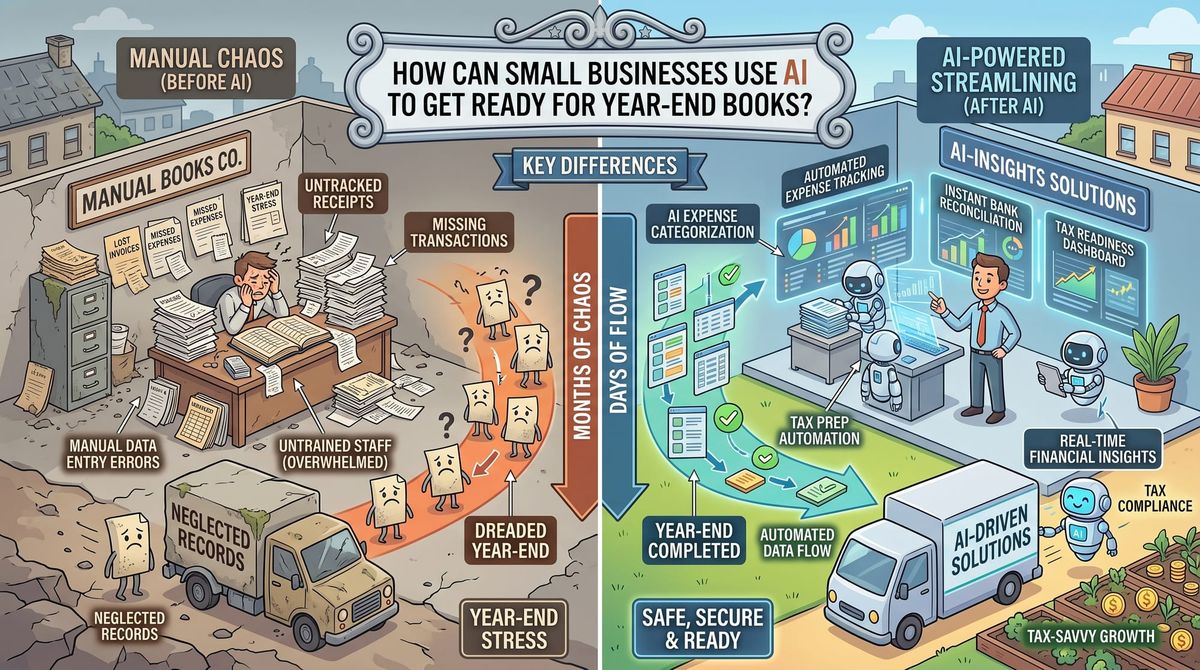
Every January, the same conversation happens. Your accountant asks for something, you don't have it, and you spend an evening digging through a year of email looking for a receipt from March.
It isn't a bookkeeping problem. It's a preparation problem — and the preparation never happens because October is busy and January feels far away.
AI can't do your books. It isn't your accountant, and nothing here is tax advice. But it's very good at the tedious parts that keep you from getting organized in the first place: sorting, listing, chasing, and turning a pile of records into a checklist.
Here's what to hand it while you still have time.
First, a rule about what you paste
Business names, invoice amounts, dates, and category questions are generally fine.
Full bank statements, account and routing numbers, card numbers, employee identification numbers, and anything covered by a client confidentiality agreement are not. If a tool isn't set up for your business specifically, treat everything you paste into it as though it could be seen by someone else. We've written about how AI assistants end up exposing more than you intended.
One more thing worth knowing: AI is unreliable at arithmetic. It will confidently add a column of numbers wrong. Use it to organize and explain, and let your spreadsheet or accounting software do the math.
Chase the money you're still owed
Start here, because it's the part with an actual return.
Pull your unpaid invoices and their dates. Then:
Here are my outstanding invoices with amounts and dates. Group them by how overdue they are, and draft a short payment reminder for each group — a light one for recently due, a firmer one for 60+ days, and a final notice for anything past 90. Keep them professional and non-hostile. I want to keep these clients.
The reason this works is that most small business owners don't chase invoices because writing the awkward email is unpleasant, not because they've decided to forgive the debt. Removing the writing removes the excuse.
Collecting in November beats writing it off in February.
Find the gaps before your accountant does
Your accountant's January questions are predictable. Get ahead of them.
I run a [type of business]. List the documents and records a bookkeeper or accountant will typically ask for at year end. Then turn it into a checklist I can tick off, and flag which items people most often can't find.
Work the checklist now, while a missing receipt is still findable and the vendor still answers the phone.
Audit what you're actually paying for
This one routinely surprises people. Pull twelve months of recurring charges off your bank and card statements — just the merchant names and amounts, nothing more.
Here's a list of recurring charges from the past year. Group them by likely category, flag anything that looks like a duplicate service, and list anything that appears to have increased in price during the year.
Most small businesses find at least one subscription nobody uses, one tool they're paying for twice, and one price increase they never noticed. Cancelling those in October saves you money for the rest of the year and shortens the list your bookkeeper has to categorize.
It also doubles as a security exercise, since every one of those vendors is holding some of your data.
Turn your questions into a real agenda
Most people go into their year-end accounting conversation with no agenda and leave having learned nothing.
I'm meeting my accountant about year-end. Here's my situation: [business type, rough size, anything that changed this year — a hire, a vehicle, a new location, equipment]. Give me a list of questions I should be asking, and explain each one in plain language so I understand what I'm asking.
Use it as a prompt sheet, not an answer sheet. The point is walking in able to ask good questions — the answers should come from the person who knows your actual numbers and your jurisdiction.
Write down what went wrong so next year is easier
While the pain is fresh, spend ten minutes capturing it. Which records were hard to find? What did you have to reconstruct? What did you promise yourself in January and not do?
Based on these problems, write me a simple monthly routine that would prevent them — under 30 minutes a month, for someone who hates bookkeeping.
Then put it in your calendar as a recurring task. A short monthly habit beats a heroic January every time, and it's the same principle as getting your business information organized so you can actually use it.
Bottom line
AI won't file anything and it won't replace your accountant. What it will do is write the invoice reminders you've been avoiding, build the checklist you never made, and turn a year of recurring charges into something you can actually read.
That's two or three hours in October instead of a bad week in January.
Need the systems behind all of this to work together — records in one place, backed up, and accessible when you need them? Our small business tech support helps owners get organized before year-end, not during it. Reach out and we'll take a look.